Types of Clocks: Every Kind Explained, From Sundials to Atomic Clocks

In short. Clocks are classified in three ways: by mechanism (how they keep time: mechanical, quartz, radio-controlled "atomic", digital, smart), by form (where they go: wall, pendulum, cuckoo, mantel, desk, alarm, grandfather, carriage, outdoor) and by display (how they show the time: analog, digital, flip, nixie, word). Most clocks sold today are battery quartz clocks. Before mechanical clocks, people told time with sundials, water clocks, hourglasses and candle clocks.
"What kind of clock is this?" usually has two answers: what it looks like, and what makes it tick. A pendulum wall clock can run on a battery, and a clock sold as "atomic" has no atom inside. This guide sorts every common type of clock by mechanism, form and display, with the history behind them, so you can name the clock in front of you or pick the right one for a room, from table clocks to pendulum wall clocks.
Types of clocks at a glance
| Classified by | Main types | The question it answers |
|---|---|---|
| Mechanism | Mechanical (pendulum, spring, weight), electric, quartz, radio-controlled, digital, smart, atomic | How does it keep time? |
| Form | Wall, pendulum wall, cuckoo, mantel, table and desk, alarm, grandfather, carriage, outdoor | Where does it go? |
| Display | Analog, digital, flip, nixie, word, projection | How does it show the time? |
| Before clocks | Sundial, water clock, hourglass, candle clock | How was time told before gears? |
Types of clocks by mechanism
The mechanism, or movement, is what keeps time. It decides how accurate the clock is, whether it ticks and how often you need to wind it, change a battery or set it.
| Mechanism | How it keeps time | Accuracy and care |
|---|---|---|
| Mechanical pendulum | A swinging pendulum releases the gears at a steady beat; a spring or falling weights supply the power | Drifts by seconds a day; wound by key or by pulling up weights, regulated by the pendulum length |
| Mechanical spring (balance wheel) | A coiled mainspring drives the gears and an oscillating balance wheel keeps the beat | Drifts by seconds a day; wound every day or every 8 days, depending on the movement |
| Electric synchronous | A motor follows the frequency of the mains power (60 Hz in North America) | Accurate while plugged in; stops in a power cut |
| Quartz | A battery makes a quartz crystal vibrate 32,768 times a second; a circuit counts the vibrations | Typically within about 15 seconds a month; one AA battery usually lasts a year or more |
| Radio-controlled ("atomic") | A quartz clock that receives a radio time signal sent from an atomic clock and resets itself | Correct to the second after each sync, changes for daylight saving time on its own |
| Digital | An electronic circuit, timed by quartz or the mains, lights LED or LCD numbers | As accurate as quartz; silent |
| Smart | Sets itself over Wi-Fi from internet time servers | Correct to the second while online |
| Atomic | Counts the vibrations of atoms, usually cesium; the second has been defined as 9,192,631,770 cesium vibrations since 1967 | The best laboratory clocks would drift by less than a second over billions of years |
Is an atomic wall clock a real atomic clock? No. A real atomic clock is a laboratory instrument. An "atomic" wall clock is a quartz clock with a radio receiver that picks up the time signal of a real atomic clock: WWVB from Fort Collins, Colorado, in the United States, MSF in the United Kingdom, DCF77 in Germany. It is a very convenient type of clock. To get one running, see how to set an atomic wall clock, and if it loses the signal, how to reset an atomic wall clock.
For what happens inside a movement, read how a mechanical clock mechanism works and how wall clock mechanisms convert energy into time.
Types of clocks by form
Form is the everyday name of a clock: it tells you where it sits and what it looks like, whatever runs it.
| Type | Where it goes | What sets it apart |
|---|---|---|
| Wall clock | Any wall | The most common type; most run on quartz |
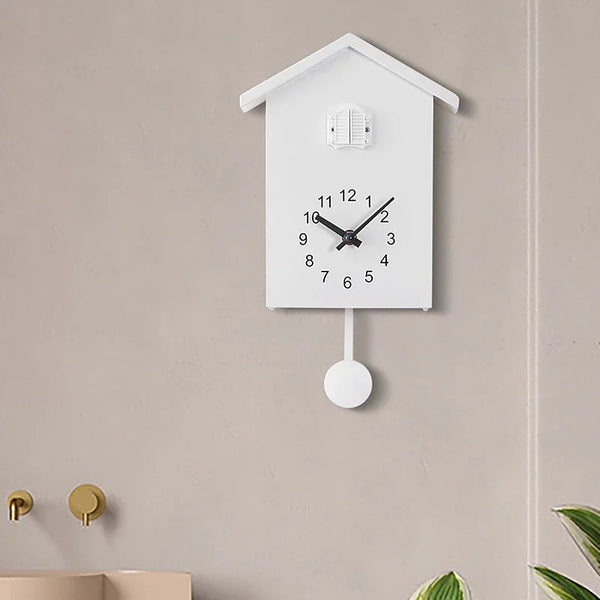
| Pendulum wall clock | Living room, hallway | A visible swinging pendulum; often quartz-driven today, with a decorative pendulum |
| Cuckoo clock | Wall | A carved house and a bird that calls the hours; from Germany's Black Forest since the 18th century |
| Grandfather (longcase) clock | Floor | A tall wooden case around a long pendulum and weights; made since the late 17th century |
| Mantel clock | Fireplace mantel or shelf | A small decorative case, often with a chime |
| Table and desk clock | Desk, nightstand, shelf | Compact and readable up close |
| Alarm clock | Bedside | Rings at a set time; analog or digital |
| Carriage clock | Shelf, travel | A small brass and glass case with a carrying handle, first made in France in the early 19th century |
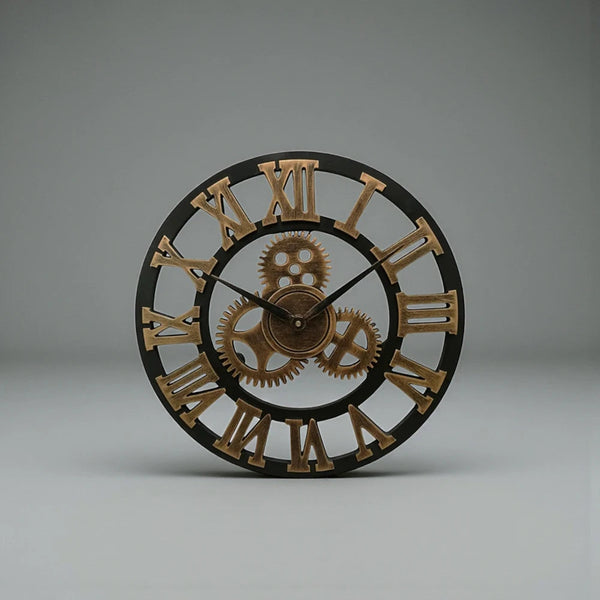
| Skeleton clock | Shelf or wall | The case and dial are cut away to show the gears |
| Outdoor clock | Garden, patio, porch | Weatherproof case, often with a thermometer |

For the most traditional forms, see our pendulum wall clocks, cuckoo clocks and the story of Black Forest cuckoo clocks. Desk and mantel models are in our table clocks and wooden desk clocks.
Types of clocks by display
- Analog: hands sweep or tick around a dial. Easy to read at a glance and from a distance. Our analog vs digital wall clock guide compares the two.
- Digital: numbers shown on an LED or LCD screen, often with the date and temperature. Silent, and easy to read in the dark.
- Flip clock: numbers printed on flaps that turn over every minute, a mechanical display popular in the 1960s and 1970s.
- Nixie tube clock: glowing digits inside glass tubes. Real nixie tubes, filled with neon, were made from the 1950s until the early 1990s; many modern "nixie" clocks use LED-lit tubes that imitate the glow.
- Word clock: a grid of letters that lights up the time in words, such as "IT IS HALF PAST TEN."
- Projection clock: beams the time onto a wall or ceiling, handy at night.

Read our flip clock buyer's guide and how nixie clocks work, or browse our flip clocks, nixie tube clocks and digital wall clocks.
The oldest types of clocks
Many lists of "types of clocks" start long before gears. These are the milestones that led to the clock on your wall:
| When | Timekeeper | What it changed |
|---|---|---|
| Over 3,000 years ago | Sundial | Told the hour from the shadow of the sun |
| By about 1500 BC | Water clock (clepsydra) | Measured time by water flowing out of a vessel, day or night |
| Early Middle Ages | Candle clock | Marked hours on a candle that burned at a steady rate |
| Late 13th century | Mechanical clock | Weights and gears drove the first tower clocks in Europe |
| 14th century | Hourglass | Measured a fixed span of time with falling sand |
| 1656 | Pendulum clock | Christiaan Huygens made clocks accurate to seconds a day |
| 1927 | Quartz clock | Built at Bell Labs; led to cheap, accurate battery clocks |
| 1955 | Cesium atomic clock | Built at the UK's National Physical Laboratory; now defines the second |
The full story is in our history of wall clocks.
Which type of clock should you choose?
- For a bedroom: a quartz clock with a sweep movement, which glides instead of ticking, or a digital clock. See quiet wall clocks for sleep.
- For a kitchen: a large, easy-to-read quartz or digital clock that wipes clean. See our kitchen wall clock guide and kitchen wall clocks.
- For a living room focal point: an oversized wall clock or a pendulum clock.
- For accuracy with no effort: a radio-controlled atomic clock or a smart clock.
- For an heirloom: a mechanical pendulum clock, wound by hand.
- For a desk or a gift: a flip clock or a nixie clock.
- For a garden or porch: a weatherproof outdoor wall clock.
Once you know the type, our guide on how to choose a wall clock covers size, style and placement.
Your questions, answered
What are the main types of clocks?
What is the most accurate type of clock?
What is the difference between a quartz and a mechanical clock?
Is an atomic wall clock a real atomic clock?
What type of clock is the quietest?
What was the first type of clock?