The history of wall clocks: from sun to design
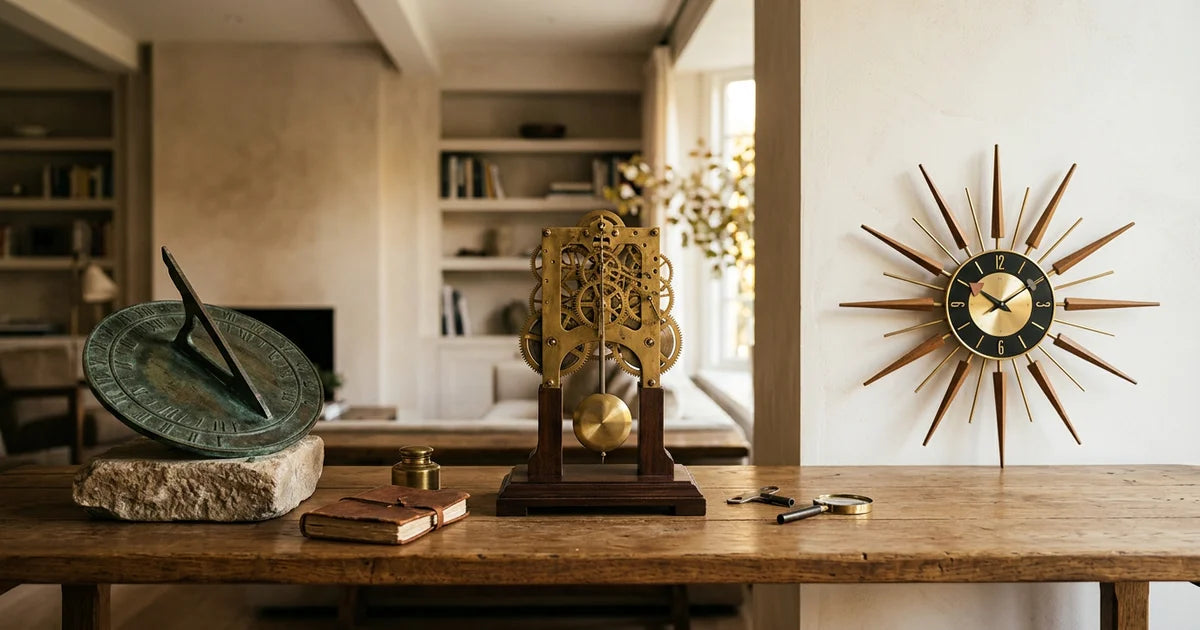
Essential to remember : Wall clocks transformed from unreliable ancient sundials into precise household essentials through Christiaan Huygens's revolutionary 1656 pendulum invention, which moved timekeeping from public towers into private homes. This evolution demonstrates how functionality merged with art during the Mid-Century Modern era, turning scientific instruments into symbols of both engineering mastery and interior design that continue to govern our modern lives.
Wall clocks evolved from crude ancient tools into precise instruments through Christiaan Huygens’s pivotal 1656 pendulum invention. This breakthrough shifted timekeeping from public towers to private homes, eventually allowing functionality to merge with art during the Mid-Century Modern era. Consequently, these objects now stand as enduring symbols of both engineering mastery and interior design.
Do you ever stop to consider the sheer frustration our ancestors endured trying to measure their days before the history wall clocks timeline brought reliable structure to human civilization? This exploration tracks the ingenious evolution of timekeeping, moving from the erratic shadows of ancient sundials to the mechanical mastery that transformed a scientific instrument into an indispensable household staple. You will uncover how medieval monastic needs, the American industrial boom, and the quartz crisis converged to shape the iconic designs and precise mechanisms that quietly govern our modern lives.
- Before the Tick-Tock: Ancient Ways of Tracking Time
- The First Clicks: How Mechanical Clocks Changed Everything
- The Great Leap Forward: The Pendulum Changes the Game
- Bringing Time Home: The Rise of the Domestic Wall Clock
- The Industrial Age: When Clocks Became a Household Staple
- A Silent Revolution: The Arrival of Quartz Precision
- More Than Just Time: The Wall Clock Becomes a Design Icon
- A Tour Through Time: Clock Styles From The 60s To The 90s
- Living With History: Making Vintage Clocks Work In Your Space
For real examples, our cuckoo clocks collection is the natural next stop.
Before the Tick-Tock: Ancient Ways of Tracking Time
The Sun as the Original Clock

Long before we had gears, we just looked up. The Egyptians and Babylonians didn't need batteries; they utilized the sundial as the first genuine tracking technology. It was primitive, yet undeniably brilliant.
Here is the logic: a stick, or gnomon, casts a shadow onto a marked surface. It is elegantly simple and effective, provided the sun cooperates. But that is the fatal flaw. Darkness or heavy clouds render this tool instantly useless.
This frustration with the weather forced our ancestors to hunt for dependable alternatives. They needed consistency, regardless of the sky.
When Sundials Failed: Water, Sand, and Fire
Enter the water clocks, or clepsydras. These became the go-to solution for the night shift. A pierced vessel lets water drain at a steady rhythm. Greeks and Romans relied heavily on them to time court speeches.
Then came hourglasses and candle clocks. Unlike heavy stone dials, you could actually carry these around. They offered a level of portability that stationary water vessels and sun trackers simply lacked.
But let's be honest, they were flawed. Despite the ingenuity, these methods lacked precision. Worse, they demanded constant human attention to flip the glass or relight the wax.
The Limits of Early Timekeeping
Here is the real issue. These tools measured duration, but they failed to provide continuous, precise time. You couldn't just glance up and know the exact hour.
Looking back at the history wall clocks eventually solved, the obstacles were maddening. Inventors were constantly fighting against the elements just to track their day:
- Sundials: Useless without direct sunlight and at night.
- Water Clocks: Prone to freezing in cold climates and inaccuracies due to water pressure changes.
- Hourglasses & Candles: Require constant human attention and are not precise for long-term timekeeping.

A small aside from that history: why clocks in ads always show 10:10.
One regional chapter deserves its own telling: the Black Forest and the cuckoo clock.
The First Clicks: How Mechanical Clocks Changed Everything
While ancient methods hit their limits, a radical shift brewed in European monasteries, swapping water and sand for gears and weights.
A Need for Order: The Monastic Influence
You might assume mechanical clocks were invented for commerce. They weren't. The origin lies with monks needing rigid structure. They required a way to track canonical hours for prayer, day or night, regardless of whether the sun was shining.
Surfacing in the late 13th century, these early contraptions were massive and crude. Most didn't even have a dial. Their sole purpose was to ring a bell at specific intervals. It was an acoustic alarm for the faithful, not a visual display.
The Age of Weight-Driven Tower Clocks
Eventually, this tech left the monastery for the town belfry. Public clocks became the ultimate flex for medieval cities, serving as a loud symbol of status and urban modernity.
Here is how it worked: a weight-driven system used gravity. As a heavy weight descended, it powered a train of gears. The rhythm was controlled by the verge escapement, a jagged mechanism that physically chopped time into ticks.
Accuracy was terrible, though. They could drift by an hour daily. Keepers had to constantly reset them against a trusty sundial just to stay close.
Still Not a Clock for the Wall
These machines were monumental and wildly expensive. They were community-funded engineering projects, not personal items. You wouldn't find one inside a home; they were strictly for the public square.
The tech simply wasn't ready for your living room. The verge and foliot system was inherently unstable and relied on massive force. You couldn't miniaturize this setup effectively for domestic use without it stopping or breaking down completely.
To truly launch the history of wall clocks, one piece was missing: a reliable regulator to tame the energy.
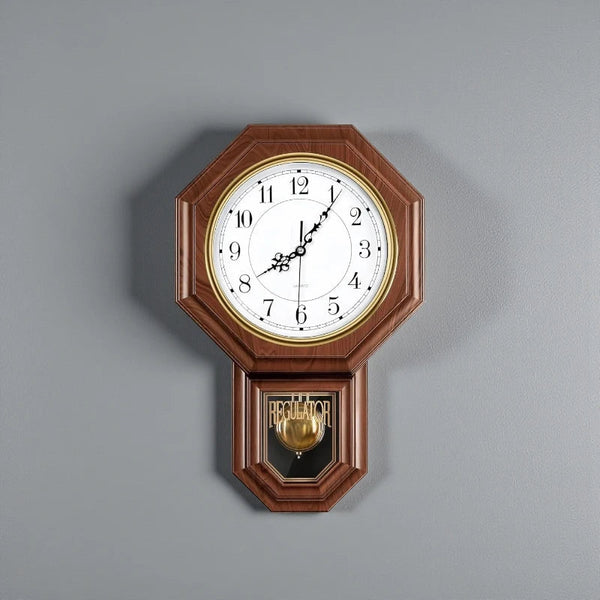
The Great Leap Forward: The Pendulum Changes the Game
This missing piece, this regulator, was to arrive thanks to the observation of a chandelier swinging in a cathedral. That's where the history of modern watchmaking really begins.
Galileo's Observation and Huygens's Invention
Legend has it that a nineteen-year-old Galileo Galilei stood in the Cathedral of Pisa, mesmerized by a swaying chandelier. Timing the swing against his own pulse, he realized the period remained constant regardless of the arc. That is the principle of isochronism.
He sketched a design for a pendulum controller, but here is the kicker: he never built it. The concept remained just that, a brilliant theory on paper waiting for a mechanic.
It took the Dutch astronomer Christiaan Huygens to actually close the loop. Building on Galileo’s groundwork, he constructed the first functional pendulum clock around 1656.

A Quantum Leap in Accuracy
You have to understand the scale of this improvement. We aren't talking about a minor tweak; clocks went from losing up to an hour a day to drifting merely seconds.
While the theory existed, it was as Christiaan Huygens demonstrated around 1657 that the mechanics truly became viable. He proved that controlling the swing was the only way to tame time, turning a rough estimate into a hard metric.
| Feature | Pre-Pendulum (Verge & Foliot) | Post-Pendulum (Huygens's Design) |
| Regulator | Foliot balance | Pendulum |
| Daily Accuracy | Error of 15-60 minutes | Error of ~10-15 seconds |
| Key Feature | Unstable, sensitive to force | Isochronous (regular) swing |
| Impact | Rough time estimation | Precise timekeeping becomes possible |
Paving the Way for Domestic Clocks
Suddenly, accuracy wasn't just for astronomers or monks. Merchants needed to track shipments; the wealthy wanted status symbols. This technology became the ultimate household must-have, driving demand for precision right into the living room.
Because the pendulum allowed for tighter, more reliable mechanisms, clocks could finally shrink. This is where the history wall clocks narrative shifts from massive towers to personal, domestic spaces.
The engineering problem was solved. Now, the challenge was purely aesthetic: how do we integrate this machine into a home?
Bringing Time Home: The Rise of the Domestic Wall Clock
With accuracy finally mastered, watchmakers could focus on a new challenge: making this scientific instrument an object that could fit into homes.
The First True Wall Clocks
It wasn't until the late 17th century that the history of wall clocks truly moved indoors. Following Huygens' discoveries, we saw the rise of "lantern clocks" and "hooded clocks" entering domestic spaces, marking a distinct shift from public towers.
These weren't subtle. Imagine a brass mechanism, often completely exposed, driving a short pendulum. You would mount the whole heavy contraption directly onto a sturdy wall console for everyone to see.
Don't be fooled, though. These remained serious status symbols, strictly reserved for the wealthy elite who could pay for such mechanics.
The Longcase Clock: A Cousin on the Floor
Around 1670, William Clement threw a wrench in the works. He utilized the anchor escapement to enable a pendulum of about one meter, vastly improving precision.
But a long swinging weight is vulnerable. It demanded a protective wooden box, leading directly to the birth of the "longcase clock", which you likely know as the grandfather clock. It was a practical solution to a mechanical problem.
While these stood on the floor, their cabinetry standards heavily influenced wall designs, pushing makers to better enclose and protect the delicate movements.
From Germany's Black Forest to the World
By the 18th century, the narrative shifted to the Black Forest in Germany. This region quickly established itself as the new nerve center for mass clock production in Europe.
Their approach was rustic but brilliant. They built mechanisms entirely out of wood. This specific production method is exactly where the famous cuckoo clock found its voice, becoming an icon of the region that persists to this day.
This shift was massive. It finally democratized timekeeping, making wall clocks affordable enough for the middle class to own, not just admire.
The Industrial Age: When Clocks Became a Household Staple
But the real democratization of the wall clock didn't come from European artisans; it came from the factories of the Industrial Revolution, particularly in the United States.
Mass Production Changes the Equation
The 19th-century Industrial Revolution completely upended the status quo. Before this, timekeeping was a luxury, but the introduction of interchangeable parts slashed costs. Suddenly, assembly lines replaced the solitary craftsman. It was a shift the history wall clocks had never seen before.
Clocks stopped being unique, handcrafted heirlooms and became accessible consumer goods. Manufacturers swapped out fragile wooden movements for stamped brass and steel. This switch made mechanisms far more durable. Reliability finally became standard, not just an expensive exception for the elite.
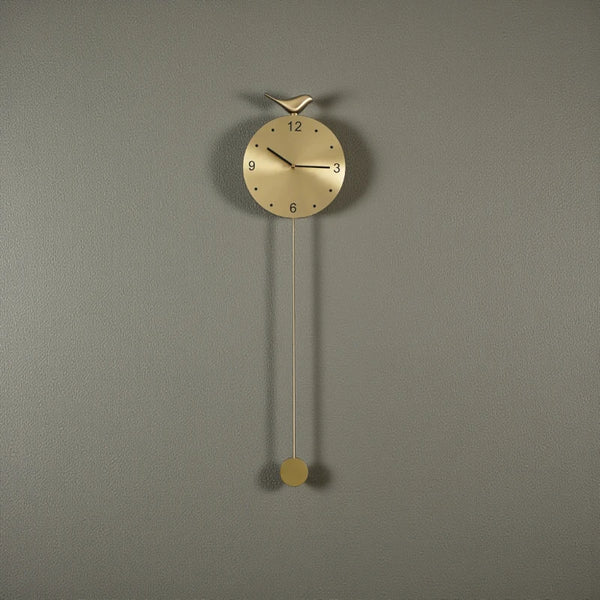
The American Clockmaking Boom
You can't talk about this era without crediting the United States. Entrepreneurs like Seth Thomas and Eli Terry were absolute pioneers here. They perfected the systems that allowed for true mass production. They turned clockmaking into a high-volume industry.
Then came the "Regulator clocks," which were simple, reliable, and incredibly precise. You started seeing them hanging on the walls of every school, train station, and office. They became the heartbeat of public infrastructure.
Quality didn't always suffer for quantity, though. Just look at companies like the E. Howard Watch & Clock Company. They proved that American manufacturers could specialize in high-quality, accurate timepieces despite the industrial scale.
The Clock in Every Home
The result of this manufacturing explosion was undeniable by the late 19th century. The wall clock transformed into a common object. It was no longer a status symbol reserved for the wealthy.
Its purpose remained strictly functional rather than decorative. Families needed these tools to organize domestic life, work shifts, and travel. Society was becoming dependent on strict schedules, and the home clock was the enforcer.
Aesthetically, they leaned traditional with dark wood cases and Roman numerals. Yet, the mechanical technology inside was at its absolute peak.
A Silent Revolution: The Arrival of Quartz Precision
For nearly 300 years, the pendulum reigned supreme. But in the middle of the 20th century, a new technology, born from research into crystals and electronics, was about to make it obsolete in just a few decades.
The Science Behind the Quartz Crystal
Let’s look at the simple genius of the quartz clock. A tiny battery sends a current into a quartz crystal. This shock makes the crystal vibrate at a hyper-specific frequency, exactly 32,768 times every second. It creates a heartbeat of unmatched consistency.
An integrated circuit counts these rapid vibrations instantly. It converts the massive count into a single, rhythmic pulse per second. That pulse pushes the hands forward.
We effectively swapped the swinging pendulum for a electronic vibration. This eliminated nearly all the complex, fragile mechanical parts.
The 1969 Disruption
The pivotal moment in the history of wall clocks arrived in 1969. That year, the Japanese company Seiko released the Astron, the first quartz wristwatch. It was expensive, but it signaled the end of the mechanical era.
Manufacturers quickly adapted this tech for walls. Quartz movements were dirt cheap to make, dead silent, ultra-precise, and only needed one battery a year. It was a total rupture from the winding keys and maintenance of the past.
The End of the Mechanical Era for the Masses
Frankly, quartz technology made traditional mechanical clocks commercially non-viable for the mass market. Why pay for maintenance when a cheap chip works better? The math just didn't add up.
Mechanical clocks retreated, becoming a niche product for collectors. We buy them now for the craftsmanship, the history, and that nostalgic "tick-tock," not for accuracy. They became art pieces rather than essential tools.
This liberation from technical constraints opened the door wide. It sparked a massive explosion of creativity in modern clock design.
More Than Just Time: The Wall Clock Becomes a Design Icon
The Mid-Century Modern Revolution
The 1940s marked a radical shift in the history of wall clocks. The Mid-Century Modern (MCM) movement didn't just tweak designs; it inverted priorities. Suddenly, telling time became secondary to pure aesthetic impact.
Designers finally ditched those heavy, dark wood cases of the past. They embraced the post-war industrial boom with open arms. Materials like molded plywood, brass, and plastics took center stage. It was a rebellion against the stuffy Victorian era.
The wall clock transformed into a decorative centerpiece for the modern home. These objects screamed post-war optimism and a desire for a brighter future.
George Nelson: The Man Who Redesigned Time
If you want to understand this era, look at George Nelson. Hired as Herman Miller's Director of Design in 1947, he was the architect of this new visual language. His influence reshaped how we perceive domestic objects.
His studio churned out icons like the Ball Clock and the exploding Starburst Clock. These weren't just timekeepers; they were sculptures. They remain the definitive symbols of MCM style today.
Nelson argued that people don't read numbers on a clock; they read the position of hands. So, he removed the digits entirely. The form itself became the function.
The New Philosophy of Clock Design
This period established a bold new philosophy: the clock is functional artwork. It stopped being a tool you hide and became art you display. The utility and beauty finally merged.
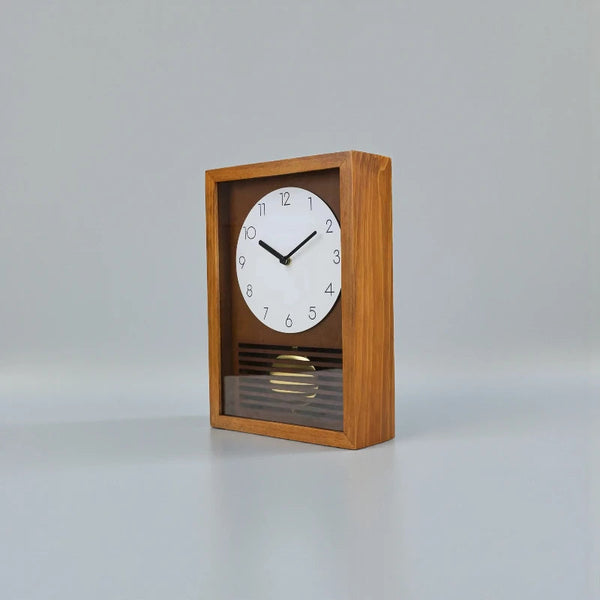
These designs broke every rule, treating walls as canvases for experimentation. Here is what defined this new approach:
- Abstract and Geometric Shapes: Moving away from traditional round or square frames.
- Bold Use of Color: Bright, optimistic colors to contrast with traditional wood tones.
- Innovative Materials: Plywood, plastics, brass, and other metals were celebrated.
- Playful and Sculptural Forms: The clock as an object of visual interest, not just a time-teller.
A Tour Through Time: Clock Styles From The 60s To The 90s
The Mid-Century Modern impulse didn't stop. Every subsequent decade used the wall clock as a canvas to express its own aesthetic trends.
The 60s And 70s: Pop Art And Earthy Tones
When tracing the history of wall clocks, the 60s stand out as a wild ride. Heavily influenced by Pop Art and the Space Age, timepieces adopted psychedelic forms. We saw molded plastics exploding in vivid orange, yellow, and lime green.
The 70s, however, brought us back down to earth with a heavier vibe. The design world shifted to an organic palette that defined the era: avocado green, harvest gold, and burnt orange.
Materials changed just as drastically during this period. Suddenly, you saw textures like macramé, dark wood, and smoked brass taking over clock design.
The 80s And 90s: Memphis Design And Minimalism
Then the 80s crashed the party. Driven by the Memphis group, clocks morphed into asymmetric geometric shapes. They flaunted bold primary colors and playful patterns that refused to be ignored.
Contrast that with the 90s, which forced a stark return to minimalism. Designs stripped away the excess, favoring cool brushed metals, glass, and dials that often ditched numbers entirely.
The objective changed completely. The clock became a discreet object, aiming to blend into the room rather than standing out spectacularly.
The Modern Era: A Melting Pot Of Styles
Today, the rules are gone. There is no single dominant style dictating the market; instead, we have a curated mix of every preceding era.
You can buy faithful reissues of MCM icons, strict Scandinavian minimalist designs, rugged industrial styles, or modern updates of traditional clocks. Everything is available at once.
Ultimately, personalization is the trend that matters. The wall clock is now chosen to align perfectly with your personal vibe.
Living With History: Making Vintage Clocks Work In Your Space
Now that we have covered this rich history, the question arises: how do we make these pieces of the past coexist with our contemporary interiors?
Choosing The Right Historical Style For Your Decor
You don't need a time machine to appreciate good design. A Mid-Century Modern clock works incredibly well in a minimalist or Scandinavian decor. It adds a necessary pop of color and shape without cluttering the visual space. It just works.
On the flip side, consider a 19th-century Regulator clock. These timber-heavy pieces bring serious warmth and character to cold industrial lofts or farmhouse kitchens. The contrast creates an unexpected visual anchor.
We aren't trying to build a dusty museum here. The goal is using the clock as a bold focal point that actually tells a story.
Placement And Scale: Practical Display Tips
Scale is the thing most people get wrong. A massive wall clock should stand alone as the sole decoration on a wall. Smaller vintage models, however, often get lost unless they are integrated into a curated gallery wall.
Before you hammer that nail, run through this quick checklist to protect your investment.
- Avoid Direct Sunlight: It can fade wooden cases and damage delicate parts.
- Steer Clear of Heat Sources: Don't hang a mechanical clock above a functioning fireplace or radiator.
- Consider the Sound: A loud 'tick-tock' might be charming in a living room but annoying in a bedroom.
- Ensure a Sturdy Mount: Antique mechanical clocks can be heavy; use a proper wall anchor.
The Best Of Both Worlds: Modern Tech In Vintage Style
Maybe you love the aesthetic found throughout the history of wall clocks but hate the maintenance. That is fair. Many vintage-style pieces now come equipped with reliable quartz movements. They offer that classic aesthetic without the constant winding or loud ticking.
If you want the ultimate "set it and forget it" solution, look for radio-controlled clocks. These devices represent the final step in our timeline of convenience. They handle the accuracy for you.
These clocks automatically synchronize with an atomic signal for perfect precision. You can learn more about how radio-controlled clocks operate directly from the experts.
From ancient sundials to mid-century modern masterpieces, the wall clock has evolved from a scientific necessity into a defining element of interior design. Whether you prefer the rhythmic tick of a mechanical antique or the silent precision of quartz, these timepieces remain timeless symbols of how we measure and style our lives.
Browser our curated modern wall clocks collection.
Your questions, answered
What methods were used to track time before the invention of mechanical clocks?
How did the invention of the pendulum revolutionize clockmaking?
When did wall clocks become affordable for the average household?
Who was George Nelson and why is he important to clock design?