Wall clock size: choose the perfect fit for every room
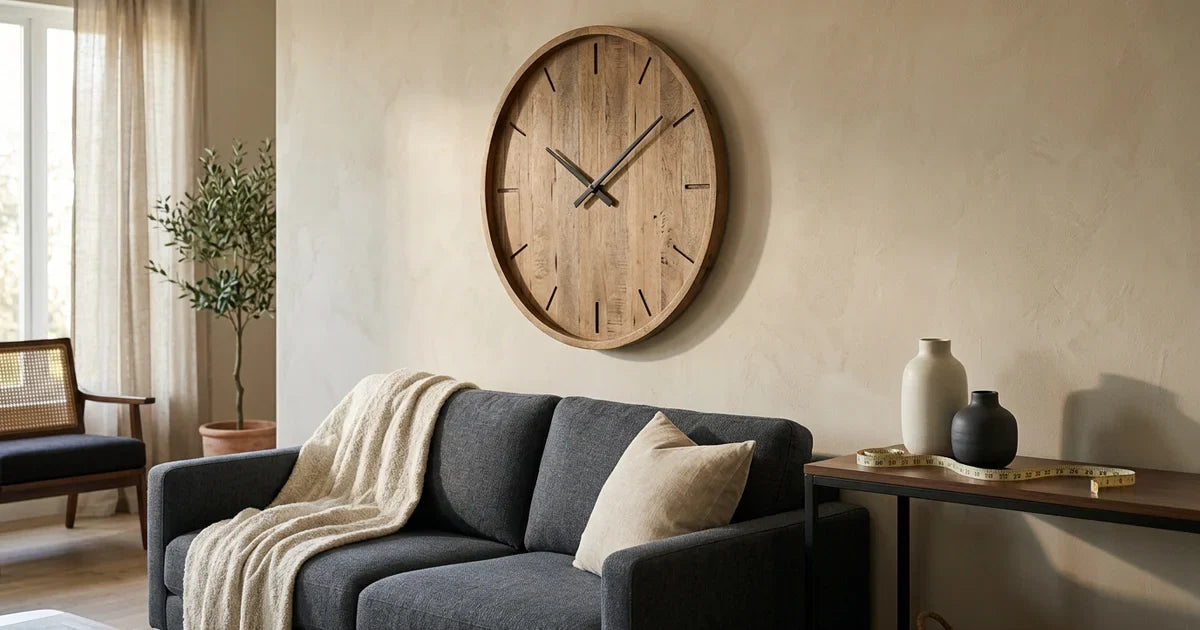
Essential to remember : Under 12 in (30 cm) : desk, shelf, small kitchen. 12-16 in (30-40 cm) : hallway, bedroom, bathroom. 16-28 in (40-70 cm) : living room, dining room, office. Over 28 in (70 cm) : large living room, loft, open space.
Leave at least half the clock's diameter as breathing room on every side.
Hang the center at 4'11"-5'3" from the floor, or 20-30 cm above any furniture below it. The farther you read from, the larger the dial and the higher the contrast you need between hands, numbers, and background.
Choosing the right wall clock depends on proportion rather than standard sizing, with the ideal diameter covering roughly two-thirds of the available wall or furniture width. This balance prevents the piece from overwhelming the room while ensuring readability. For maximum visual harmony, the center of the clock should align with eye level, approximately 1.60 meters from the floor.
Without a reliable wall clock size guide, you risk hanging a timepiece that looks comically small or awkwardly dominant against your living room wall, ruining the aesthetic you worked hard to create. This article solves that frustration by teaching you how to master scale and align specific dimensions with your room's unique architecture for a flawless look. You will discover the exact proportions designers use to balance visual weight and depth, ensuring your next purchase serves as a harmonious focal point rather than a mismatched accessory that disrupts your decor.
- Start with the Fundamentals: Scale, Proportion, and Your Wall
- Beyond Diameter: Understanding Visual Weight and Depth
- A Practical Guide for Every Room in the House
- Getting the Placement Just Right
Start with the Fundamentals: Scale, Proportion, and Your Wall
The Two-Thirds Rule You Can Actually Use
Most designers swear by filling about two-thirds to three-quarters of the available wall space with your timekeeper. It's a solid baseline for a wall clock size guide, not a rigid commandment.

This logic applies equally when hanging above a console; the clock needs to balance the furniture, not just the drywall.
Don't follow this blindly, though. A clock isn't just a static painting; it has a job to do. Your goal is visual harmony and readability, which often trumps sticking to a strict mathematical formula.
Why "Standard" Clock Sizes Are a Myth
There is no such thing as a "standard" size. Manufacturers churn out diameters ranging from tiny 12 in (30 cm) pieces to massive meter-wide giants, so the right choice depends entirely on your specific room.
A modest 16 in (40 cm) clock works in an office, yet that same piece would vanish on a large living room wall.

It comes down to proportion and the clock's actual job. Is this a functional tool for checking the time, or the room's artistic centerpiece? That answer dictates the diameter far more than any catalog label.
Key Factors Before You Even Measure
Before grabbing the tape measure, ask yourself the hard questions. Buying a clock blind is the fastest way to waste money on decor that feels "off." Look at the bigger picture first.

- Wall space: How much empty, usable space do you actually have to work with?
- Viewing distance: From where will you most often be looking at the clock? Across the room or up close?
- Purpose: Is this purely a functional tool or is it a statement piece meant to draw the eye?
Beyond Diameter: Understanding Visual Weight and Depth
Now that the basics of proportion are clear, we need to go further. If you stop at diameter, you risk making a serious error, because the clock's design changes the game completely.
How a Clock's Style Changes Its Perceived Size
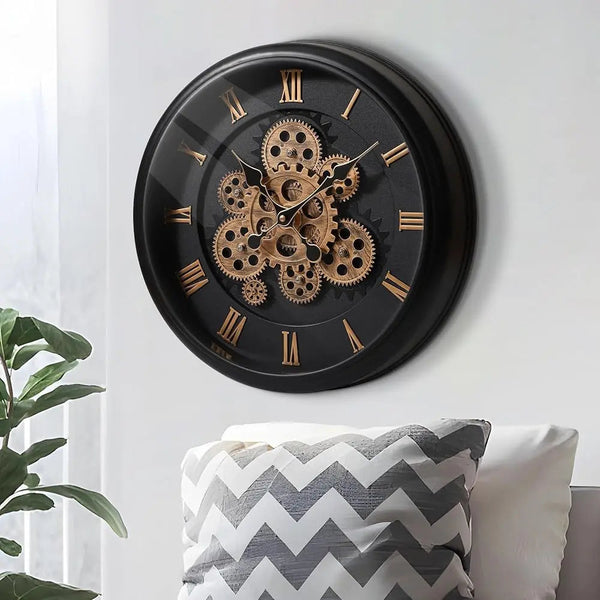
You might think 24 in (60 cm) is just 24 in (60 cm), but you'd be wrong. This is where visual weight tricks the eye. A minimalist clock with thin hands looks significantly smaller than an industrial piece with exposed gears and a thick frame, even if they share the exact same dimensions.
A complex, bold design aggressively eats up wall space. It demands more negative space, or "breathing room", around it to avoid looking like a cluttered mess that overwhelms the room.
Conversely, a clean, stripped-back design often needs a larger diameter to make any real impact.

Don't Forget About Depth
Most people obsess over diameter and completely ignore the clock's depth. It's a classic oversight. A thick clock projects outward from the wall, physically intruding into the room's volume.
In a narrow hallway or small entryway, a deep clock quickly becomes a physical obstacle you might bump into. It also casts harsh shadows that can ruin readability depending on your lighting.
Keep in mind that mechanical clocks are usually much deeper than standard quartz models, so factor that bulk in.
Measuring What Matters
So, how do you get this right? Your wall clock size guide starts with the diameter, measured edge-to-edge at the widest point. But don't stop there; you must record the case depth too.
- Low Visual Weight: A minimalist clock with a thin frame and simple hands. It occupies space physically but not visually. You can go larger.
- High Visual Weight: A rustic wooden clock with large Roman numerals and exposed gears. It feels substantial and requires more negative space around it.
A Practical Guide for Every Room in the House
Theory is fine, but let's get practical. How does all this actually apply to your living room, kitchen, or bedroom?
The Living Room: Statement Piece or Subtle Accent
The living room is often the ideal spot for a large wall clock. Placed above the sofa or fireplace, it acts as a powerful focal point that anchors the room.
Aim for a diameter between 24 and 36 in (60-90 cm) for real impact, ensuring it isn't wider than the furniture below.
If you have a busy gallery wall, opt for a smaller accent clock rather than dominating the ensemble.
The Kitchen and Office: Function Meets Form
In the kitchen or office, readability is the priority. You need instant clarity when glancing up while working.
Since walls here are often cluttered, a medium-sized clock (12-20 in / 30-50 cm) is the best choice. It's large enough to be read easily.
Place it above a doorway or on a clear wall section for maximum visibility.
Your Quick-Reference Sizing Chart
To simplify, here are some guidelines acting as your wall clock size guide. These aren't absolute rules, but an excellent starting point to refine your choice based on your space.
| Clock Size | Best Rooms | Min. Wall Space | Key Consideration |
| Under 12 in (30 cm) | Desk, shelf, small kitchen | Above a piece of furniture | Accent piece, not a focal point |
| 12-16 in (12-16 in (30-40 cm)) | Hallway, bedroom, bathroom | 3 ft (1 m) free width | Keep it silent for bedrooms |
| 16-28 in (16-28 in (40-70 cm)) | Living room, dining room, office | 5 ft (1.5 m) free width | Best balance of readability and impact |
| Over 28 in (70 cm) | Large living room, loft, open space | 8 ft (2.5 m) free width | Statement piece - give it breathing room |

Getting the Placement Just Right
You've finally found the perfect clock. Don't ruin it with bad placement. This wall clock size guide proves that where you hang it is just as decisive as its size.
The Eye-Level Rule, and When to Break It
The basic rule in decoration is to hang artwork at eye-level. For a clock, this means its center should sit between 4'11" and 5'7" from the floor, with 5'3" being the standard reference. That is the average viewing height. It simply looks better.
But this rule has its limits. If you place the clock above a sofa, you will mostly view it while seated. You must lower it a bit.
A good trick: leave about 8 to 12 in (20-30 cm) between the top of the furniture and the bottom of the clock.
The Link Between Size and Viewing Distance
There is a direct relationship between the clock size and the actual viewing distance. It seems like common sense, yet many people completely forget it.
If you have a long living room and want to read the time from across the room, a small 12 in (30 cm) clock simply won't suffice. Prioritize a large dial with high contrast between the background, hands, and numbers.
The greater the distance, the larger the clock diameter must be to remain readable.
Your Final Hanging Checklist
Before drilling a hole in the wall, do this final check. It will save you from regrets.
- Is it centered on the wall or the furniture below it?
- Is the center at the correct height (eye-level or adjusted for seating)?
- Have you stepped back to check the proportions from across the room?
- Does it have at least half its diameter as empty space on every side?
Ultimately, choosing the correct wall clock size relies on balance rather than rigid rules. By considering scale, visual weight, and proper placement, you transform a functional tool into a stunning design element. Trust these guidelines to find a timepiece that perfectly harmonizes with your space and enhances your home's decor.
Smaller spaces suit our compact modern wall clocks without overwhelming the room.
Your questions, answered
What is considered a good size for a wall clock?
How do I go about choosing the right size wall clock?
How should I correctly measure the size of a wall clock?
Is it possible for a wall clock to be too big for a room?