Roman Numeral Clocks: How to Read Them and Why Four Is Written IIII
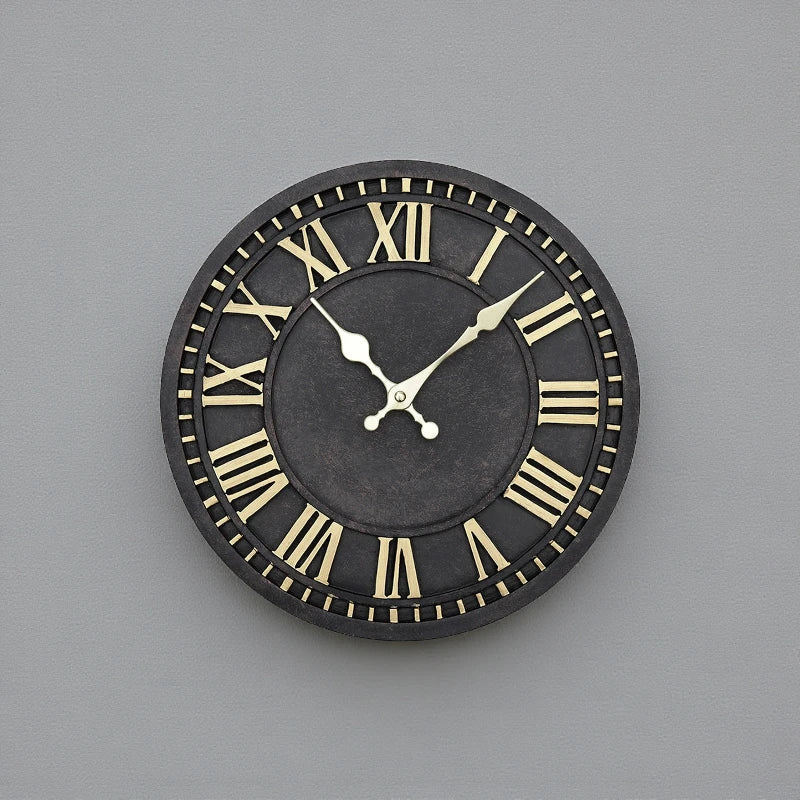
In short. A Roman numeral clock shows the hours as I to XII instead of 1 to 12. You read it like any analog clock: the short hand points to the hour, and the long hand counts the minutes, 5 minutes per numeral. Most clock faces write four as IIII rather than IV, a centuries-old tradition known as the "clockmaker's four"; the Great Clock of Westminster, better known as Big Ben, is a famous exception with IV.
Roman numerals are the classic face of the wall clock, from station clocks to farmhouse kitchens. They can slow down anyone who is not used to them, and they hide a small puzzle: why is four written IIII? This guide shows how to read a Roman numeral clock in seconds, explains the IIII, and helps you decide whether this style suits your room.
Roman numerals on a clock face
The table gives each numeral, the hour it stands for, and the minutes when the long hand points at it.
| Numeral | Hour (short hand) | Minutes (long hand) |
|---|---|---|
| I | 1 | :05 |
| II | 2 | :10 |
| III | 3 | :15 (quarter past) |
| IIII or IV | 4 | :20 |
| V | 5 | :25 |
| VI | 6 | :30 (half past) |
| VII | 7 | :35 |
| VIII | 8 | :40 |
| IX | 9 | :45 (quarter to) |
| X | 10 | :50 |
| XI | 11 | :55 |
| XII | 12 | :00 (o'clock) |
The rule behind the numerals: I is 1, V is 5 and X is 10. A smaller numeral after a larger one is added (VI = 5 + 1), and a smaller one before a larger one is subtracted (IX = 10 minus 1).
How to read a Roman numeral clock
- Find the short hand and read the numeral it points to. If it sits between two numerals, the hour is the one it has just passed.
- Find the long hand and count 5 minutes for each numeral from XII. On VII, it is 35 minutes past the hour.
- Put the two together. Short hand just past IIII, long hand on VII: it is 4:35.
The quickest landmarks are the four quarters: XII at the top, III on the right, VI at the bottom and IX on the left. Many dials also print small minute marks between the numerals, which makes reading the exact minute easier. Why clocks in shops are set to 10:10 is another tradition of the dial: see why clocks show 10:10.
Look at four o'clock on the outdoor clock at the top of this page: it reads IIII, not IV.
Why do clocks use IIII instead of IV?
Look at almost any Roman numeral clock and four is written IIII, while nine stays IX. Nobody knows for sure why, but these are the explanations most often given:
- Visual balance: IIII mirrors VIII on the other side of the dial, so the left and right halves of the face look even.
- Easier to make: with IIII, the twelve numerals use exactly 20 I's, 4 V's and 4 X's, a set that divides neatly when the numerals are cast or cut.
- The Romans did it too: IIII was a common way to write four in ancient Rome; the shorter IV became the rule only later.
- Clarity: IV and VI are mirror images, easy to mix up on dials where the numerals turn with the circle.
- Legend: a popular story credits a French king who preferred IIII, but there is no evidence for it.
Some famous clocks do use IV, the Great Clock of Westminster among them. Both forms are correct on a clock face; IIII is simply the tradition. For more on how the dial took its shape, read our history of wall clocks.
Choosing a Roman numeral clock
| Style | Typical look | Where it works |
|---|---|---|
| Station or outdoor clock | Large bold numerals on a dark or white dial | Garden, porch, large walls |
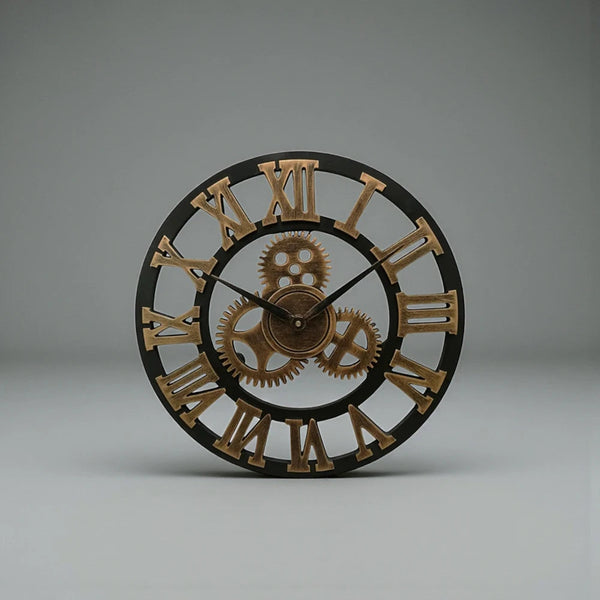
| Industrial gear clock | Open frame with cut-out numerals and visible gears | Living room, loft, office |
| Vintage and farmhouse | Aged finish, cream dial, slim numerals | Kitchen, dining room, hallway |
| Skeleton desk clock | Ring of numerals around a visible movement | Desk, shelf, gift |
- Readability: Roman numerals take a little longer to read than Arabic numbers, especially from across a room. For a large space, pick big, high-contrast numerals; our guide to reading a wall clock from a distance gives sizes.
- For children learning the time: a dial with Arabic numbers is easier to start with.
- Style: Roman numerals suit traditional, vintage and industrial interiors; for a modern room, a slim minimalist Roman dial keeps the look light.
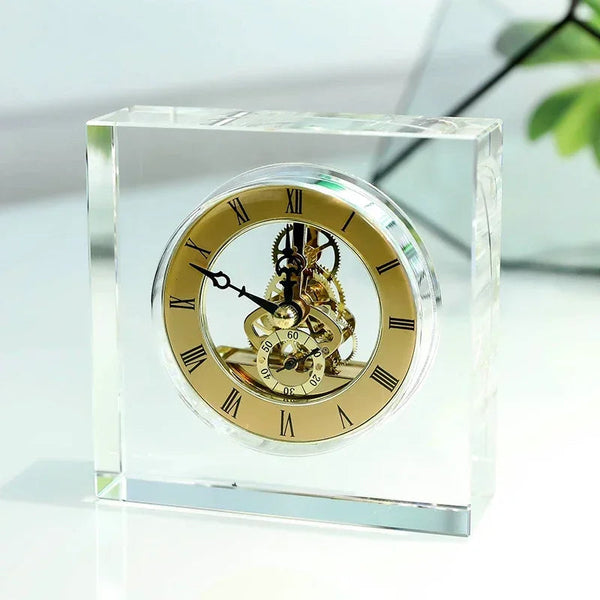
Roman numerals also appear on desk clocks, such as this crystal skeleton clock with its ring of numerals around the movement. Browse our table clocks and outdoor wall clocks, or compare every style in our guide to types of clocks. For size, placement and movement, see how to choose a wall clock.
Your questions, answered
Why do clocks use IIII instead of IV?
How do you read a Roman numeral clock?
What is 4 on a Roman numeral clock?
Does Big Ben use IIII or IV?
Are Roman numeral clocks hard to read?
What does XII mean on a clock?