How to choose a wall clock? Size, style & placement
To go straight to the point: successful wall clock selection depends on matching the diameter to the wall size and the mechanism to the room's purpose. A 60cm model acts as a focal point in spacious areas, while silent sweep movements remain essential for quiet zones like bedrooms. This balance guarantees a functional accessory that enhances the decor without overwhelming the space.
Have you ever installed a stylish timepiece only to discover its relentless ticking keeps you awake or its size feels completely lost on your large wall? To successfully choose the right wall clock, you must look beyond simple aesthetics to find the balance between functional silence and the proportional design that anchors your room. We reveal the specific rules for matching scale to your decor and selecting between silent sweep or traditional movements, guaranteeing a practical accessory that enhances your home's atmosphere without compromising your peace of mind.
- Mastering the Scale: Finding the Perfect Clock Size
- Style and Aesthetics: Matching Your Interior Decor
- Strategic Placement: Height and Location Rules
- Functionality and Precision: Beyond the Look
Mastering the Scale: Finding the Perfect Clock Size
We often start with aesthetics, but dimension actually dictates the success of your decor.
How to Determine the Right Size for Your Room
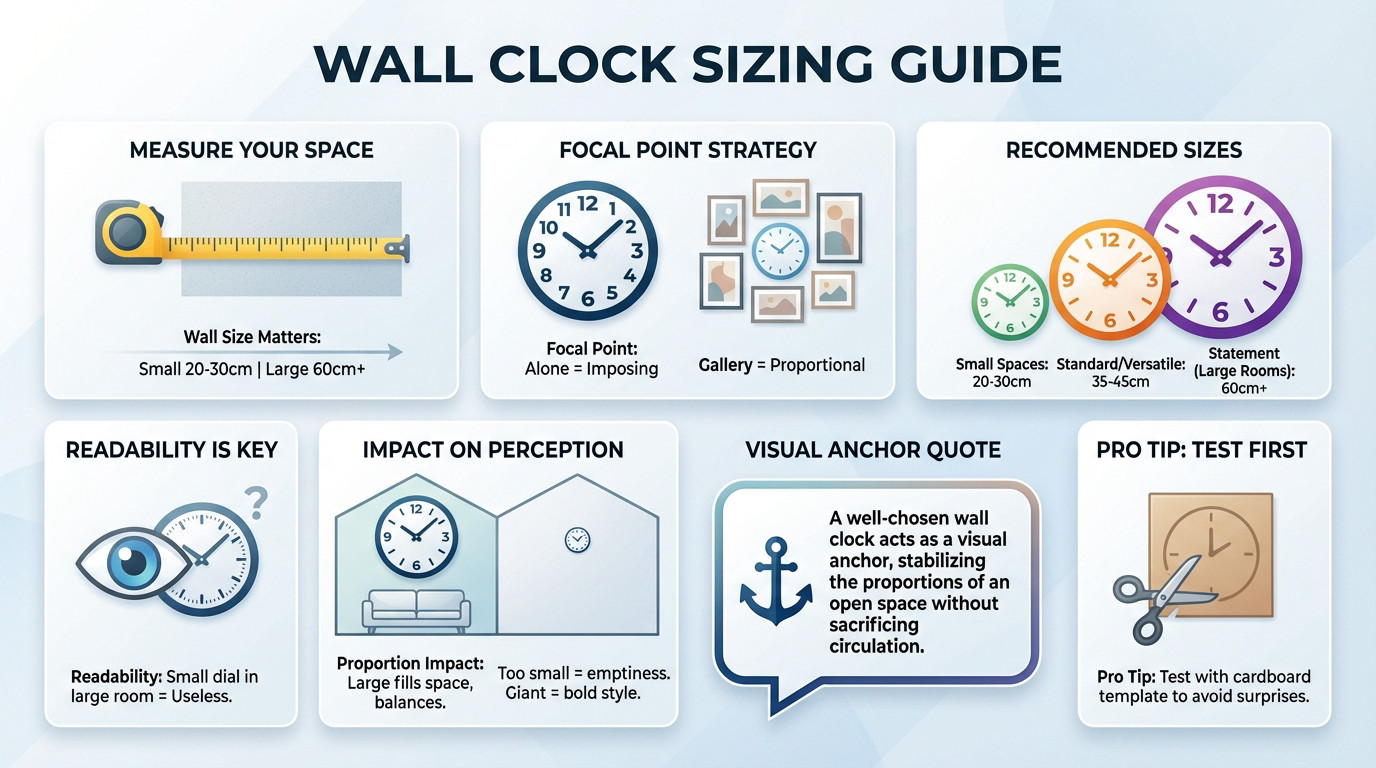
Start by grabbing a tape measure to assess your available wall space. When asking Silent or Ticking? How to Choose the Right Wall Clock for Your Space, physical scale is the first variable. For a narrow column, a 20 to 30 cm clock fits perfectly. However, a sprawling wall demands a diameter of 60 cm or more.
Think about the clock as a deliberate focal point. If it hangs alone, it must command attention to avoid looking lost. When surrounded by photo frames, keep the size proportional to its neighbors.
Here is the breakdown for choosing the right diameter:
- Small spaces require a compact 20-30 cm diameter.
- Standard versatile models usually measure 35-45 cm.
- Statement clocks for large volumes start at 60 cm.
Never forget that readability relies entirely on physical size. A tiny dial in a massive living room is practically useless.
The Impact of Proportions on Room Perception
A massive clock does more than tell time; it fills a void. It serves as a powerful tool to balance architectural volumes. You get visual weight without cluttering your valuable floor space.
"A well-chosen wall clock acts as a visual anchor, stabilizing the proportions of an open space without sacrificing circulation."
The most common mistake involves picking a model that is too small. It creates an awkward void and feels unfinished.
Size directly dictates the room's mood. A giant clock imposes a bold, assumed style.
Minimalist models compensate for discretion with clean lines. Balance remains the absolute priority here.
Always test the gauge with a cardboard cutout. This simple trick prevents post-purchase regret.
Style and Aesthetics: Matching Your Interior Decor
Once the size is defined, it is time to tackle the pure look so the object blends into your universe.
Choosing a Style That Complements Your Atmosphere
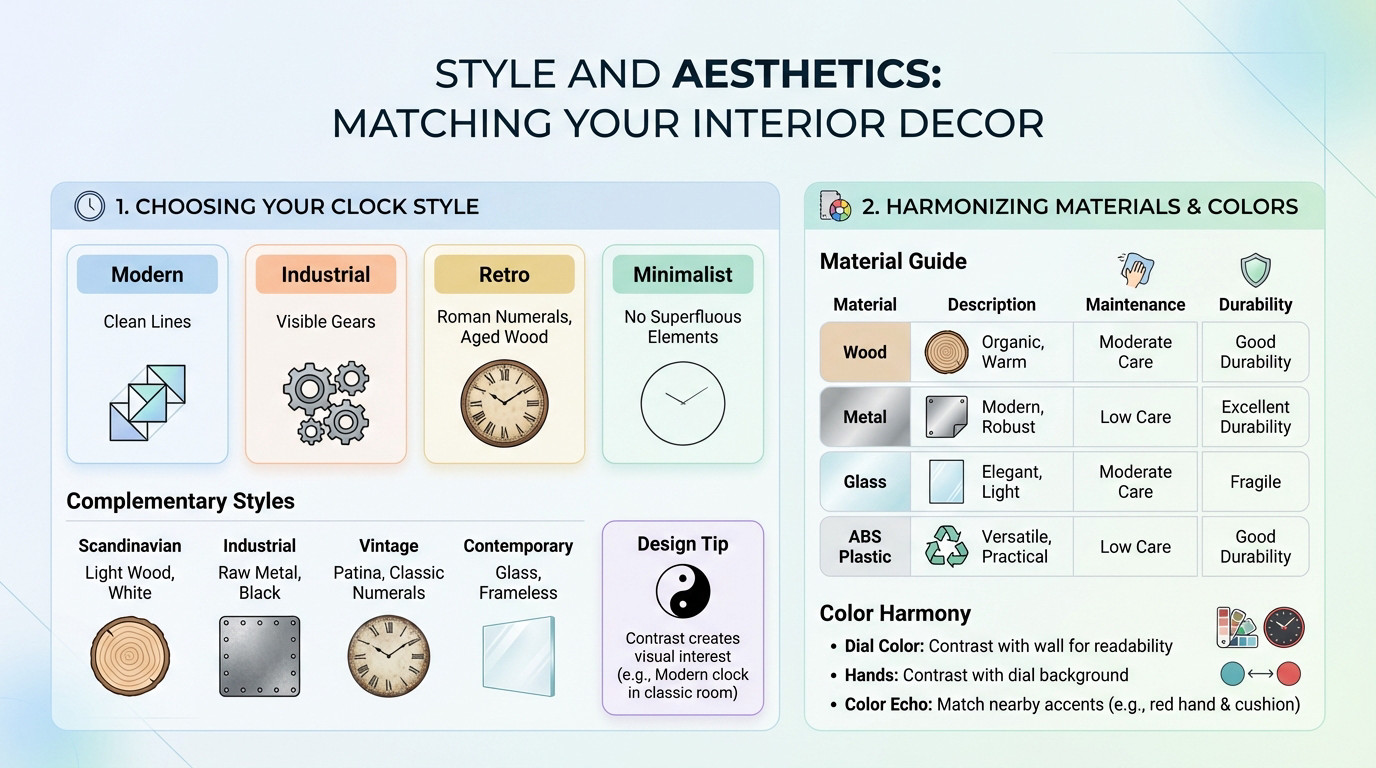
When asking Silent or Ticking? How to Choose the Right Wall Clock for Your Space, style is key. Modern interiors demand clean lines. Industrial designs rely on raw metal and visible gears. Retro lovers hunt for Roman numerals and aged wood finishes. Minimalist spaces strip away everything superfluous.
Your clock needs to speak the same language as your furniture. A matte black metal piece sits perfectly above a heavy industrial dining table. It creates a cohesive look that just works.
Here is a quick breakdown of common pairings:
- Scandinavian: Light wood and white tones.
- Industrial: Raw metal and black accents.
- Vintage: Patina finishes and classic digits.
- Contemporary: Glass faces without frames.
Don't be afraid to break the rules with contrast. Placing an ultra-modern clock in a classic room creates a sharp visual rupture.
Harmonizing Materials and Colors
Finishes make or break the vibe of the room. Brass brings immediate warmth, while wood offers an organic touch. If choosing plastic, pick high-quality ABS to avoid looking cheap.
| Material | Ambiance created | Maintenance | Durability |
|---|---|---|---|
| Wood | Warm, natural | Wax occasionally | High |
| Metal | Industrial, sleek | Dust often | Very High |
| Glass | Elegant, airy | Glass cleaner | Fragile |
| Plastic ABS | Modern, playful | Easy wipe | Medium |
The dial color must cut through the wall shade for readability. You can't read a dark clock on a navy wall. Dark backgrounds demand light or metallic faces to pop.
The hands are the final detail that matters most. Their color must contrast sharply against the dial background.
Think about subtle color echoes in the room. A red second hand can nicely pick up the tone of a nearby cushion.
Strategic Placement: Height and Location Rules
Style is useless if nobody can read the time without craning their neck.
The Eye-Level Rule and Optimal Height
The golden rule is eye level. On average, fix the center 1.55m off the ground. Even when considering Silent or Ticking? How to Choose the Right Wall Clock for Your Space, position matters. This allows natural reading without effort.
Adjust based on your usual position. In a living room, you check time while seated. Lower it slightly so it stays in your comfortable field of view.
- Measure the ideal height on your wall.
- Mark the exact center point.
- Check alignment with nearby furniture.
- Drill and fix the mount securely.
Avoid placing it too close to the ceiling. This compresses the room and makes the object visually crushing.
Adapting Placement to Room Function
Every room has distinct needs. In the kitchen, place it right near the cooking zone. That is where timing is the most critical.
In a home office, the clock must face you but not be too imposing. It structures your work sessions without becoming a source of stress.
For the entryway, it acts as a last reminder before leaving. Make it visible the moment you walk through the door.
Avoid reflection zones entirely. Direct light from a window often makes the glass unreadable.
Leave air around it. Don't stick the clock against a frame or tall furniture.
Safety counts too. Anchor it solidly, especially in those high-traffic passage areas.
Functionality and Precision: Beyond the Look
Beyond mere aesthetics, asking Silent or Ticking? How to Choose the Right Wall Clock for Your Space comes down to function. A clock is a measuring instrument that must either fade into the background or make its presence heard.
Silent Sweep vs. Traditional Ticking
Selecting the right movement is vital for your daily acoustic comfort. A sweep mechanism stays totally silent with a fluid hand. Conversely, traditional ticking offers a rhythmic presence. You might actually find that steady beat surprisingly soothing.
For a bedroom or quiet office, silence is non-negotiable. Nothing is more annoying than repetitive noise when you try to sleep. That sound kills concentration instantly.
You need to understand this simple fact.
"The silence of a continuous sweep mechanism transforms the wall clock into a purely visual object, eliminating any auditory distraction in your resting spaces."
It changes the room's vibe.
In a busy kitchen, ambient noise often masks the ticking. It becomes strictly a matter of personal taste.
Precision and Radio-Controlled Technology
If precision is your main priority, look for radio-controlled models. These clocks catch a signal to stay on exact time. You can learn about the WWVB radio station technology here. It explains how they sync perfectly.
These models handle daylight savings time automatically. It is a huge comfort to avoid taking the object down twice a year. You save time and hassle.
Watch out for potential signal reception issues though. Thick walls or heavy electronics can sometimes block the synchronization completely. Check this guide on troubleshooting signal reception issues.
For most people, a standard quartz movement is enough. The time drift is minimal over months of use.
Ultimately, selecting the right wall clock involves balancing practical utility with aesthetic appeal. Whether choosing a silent sweep movement for a peaceful bedroom or a metal design for an industrial look, prioritize your specific needs. Regular maintenance will ensure your timepiece remains precise and enhances your interior decor for years.
FAQ
What is the ideal wall clock size based on room dimensions?
Determining the right size depends heavily on your available space. For smaller areas like bedrooms or hallways, a diameter between 12 and 16 inches (30 to 40 cm) is generally sufficient. In medium-sized rooms such as a standard living room or office, a clock measuring 16 to 28 inches (40 to 70 cm) allows the piece to stand out without overcrowding the wall.
For expansive spaces like a large foyer or an open-plan living area, a statement clock exceeding 28 inches (70 cm) provides the necessary visual impact to fill the volume. Always measure your wall first; a clock that is too small may be hard to read, while one that is too large can overwhelm your existing decor.
How do I balance the scale of a clock with my furniture?
Achieving visual harmony requires balancing the clock with the furniture below or around it. A large clock acts as a focal point and works best on an open wall or centered above a substantial, low piece of furniture like a sideboard. It should anchor the space without making the furniture look diminutive.
Conversely, smaller clocks (under 16 inches) often look lost if placed alone on a large wall. They integrate better when grouped with other decorative elements, such as framed art or shelves. The goal is to ensure the clock is proportional to the surface it occupies and the furniture adjacent to it.
Can a wall clock change the perceived size of a room?
Yes, the size of your clock significantly influences the perception of space. In a compact room, a large oversized clock can serve as a bold strategic choice, creating a strong focal point that adds depth and character. However, in a spacious room with high ceilings, a small clock will likely disappear, making the wall feel empty and the design unfinished.
To balance high ceilings or large volumes, prioritize larger diameters that draw the eye upward and stabilize the vertical proportions. The right size acts as a visual anchor, helping to structure the space rather than just filling a void.
Which clock material is best for durability and maintenance?
If robustness and longevity are your top priorities, metal clocks (aluminum, steel, or brass) are the ideal choice as they are durable and easy to clean. Glass offers a sleek, contemporary elegance perfect for modern interiors, but it is inherently fragile and requires careful handling during cleaning or battery changes.
Wood is excellent for adding warmth and suits Scandinavian or rustic styles, though it may require specific care to preserve the finish. When choosing, consider the room's activity level; for instance, avoid fragile materials like glass in high-traffic areas or children's rooms to ensure safety and longevity.
At what height should I hang my wall clock for the best visibility?
The general rule for optimal visibility is to hang the center of the clock at eye level, which is typically between 61 and 63 inches (1.55 to 1.60 meters) from the floor. This allows you to read the time comfortably without tilting your head up or down.
However, you should adapt this height to the room's function. In a living room where you are primarily seated, it is advisable to lower the clock so that the bottom edge sits approximately 8 inches (20 cm) above the back of your sofa or armchairs, keeping it within a comfortable field of view.
You May Also Enjoy
-
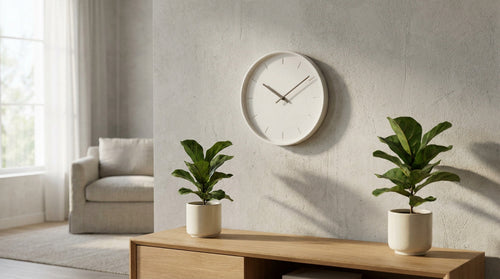
Minimalist wall clock: the beauty of less is more
Minimalist wall clocks, exemplified by Muji and Arne Jacobsen designs, prioritize clarity and clean lines to merge utility with decor. This approach transforms a simple time-telling tool into functional wall art that reduces visual noise, creating a calmer and more mindful interior environment.
-
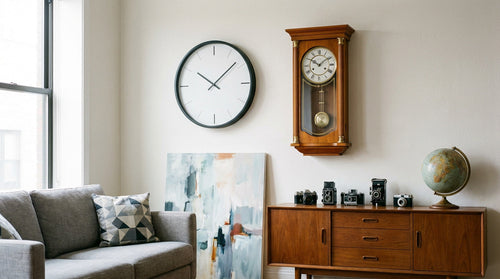
Modern vs vintage wall clocks: finding your perfect match
The choice between modern and vintage clocks fundamentally alters a space's character. Modern designs deliver silent precision and minimalist aesthetics, while vintage models add historic warmth through patina and mechanical ticking. The decision ultimately rests on prioritizing sleek, maintenance-free functionality or the soulful, rhythmic presence of traditional craftsmanship.
-
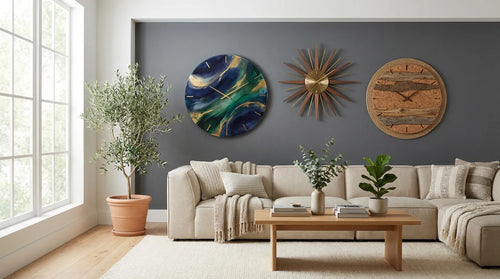
Wall clock trends 2026: the new statement pieces
In 2026, wall clocks evolve from mere tools into oversized, artistic statement pieces that anchor a room's design. Dominated by Mid-Century Modern and Sophisticated Minimalist aesthetics, this trend emphasizes sustainable materials like natural wood and brushed metal, marking a definitive shift toward functional sculpture over simple timekeeping.
-
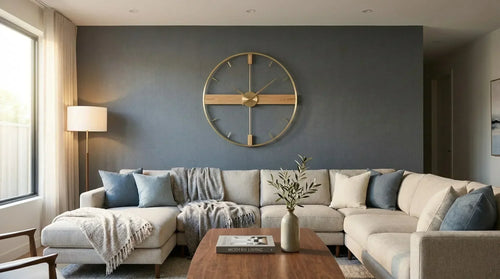
Choosing a wall clock for your living room: 2026 edition
A living room clock serves as a major focal point, so selecting a scale that fills roughly two-thirds of the wall space is crucial for visual balance. Beyond aesthetics, prioritizing a silent quartz mechanism ensures the room remains a peaceful sanctuary, perfectly blending bold design with practical function.
-
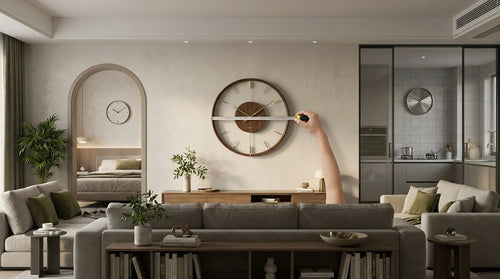
Wall clock size: choose the perfect fit for every room
Choosing the right wall clock depends on proportion rather than standard sizing, with the ideal diameter covering roughly two-thirds of the available wall or furniture width. This balance prevents the piece from overwhelming the room while ensuring readability. For maximum visual harmony, the center of the clock should align with eye level, approximately 1.60 meters from the floor.
-
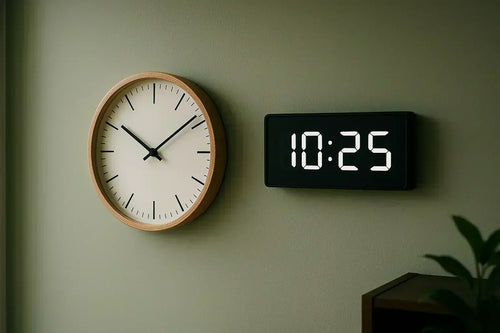
Is a wall clock analog or digital?
Looking to choose between analog and digital wall clocks? The essential takeaway: Analog clocks offer timeless design and educational value, while digital clocks provide instant readability and advanced features like temperature display. Hybrid models merge both, offering precise timekeeping with aesthetic versatility. Both can achieve atomic-level accuracy, ensuring your space balances style, functionality, and precision.
-
Which wall clock is good as per vastu?
-
Why a wall clock is the perfect gift for any occasion
A well-chosen wall clock transcends mere functionality, becoming a meaningful gift that blends aesthetics with practicality. It enhances home decor while serving as a daily reminder of connection. Perfect for housewarmings, weddings, or anniversaries, personalized touches transform it into a cherished symbol of shared moments and thoughtful gestures.