Mechanical clock mechanism: how it actually works?
Mechanical clocks rely on a precise chain where energy from weights or springs drives gears, controlled by the escapement and pendulum. Understanding this mechanism ensures better maintenance, such as adjusting the pendulum lens for accuracy. Notably, Christiaan Huygens’ 17th-century application of pendulum theory revolutionized this system, transforming raw energy into reliable timekeeping.
Have you ever wondered why your heirloom timepiece stops unexpectedly or exactly how the heavy weights generate consistent torque to drive the hands around the dial without electronics? Understanding how mechanical wall clocks actually work reveals a precise engine where potential energy transforms into kinetic motion through a sequence of brass gears to measure every second. We break down the distinct synchronization between the power source and the escapement to help you master the delicate art of regulation and ensure your historic mechanism keeps accurate time for decades to come.
- Core Components of Mechanical Clock Movements
- The Power Source: Springs vs. Weights
- The Transmission and Regulation System
- Maintenance and Fine-Tuning for Longevity
Core Components of Mechanical Clock Movements
To truly understand Inside the Gears: How Mechanical Wall Clocks Actually Work, we must first distinguish the raw engine from the aesthetic body. The exterior style might catch your eye, but the internal mechanics do the heavy lifting.
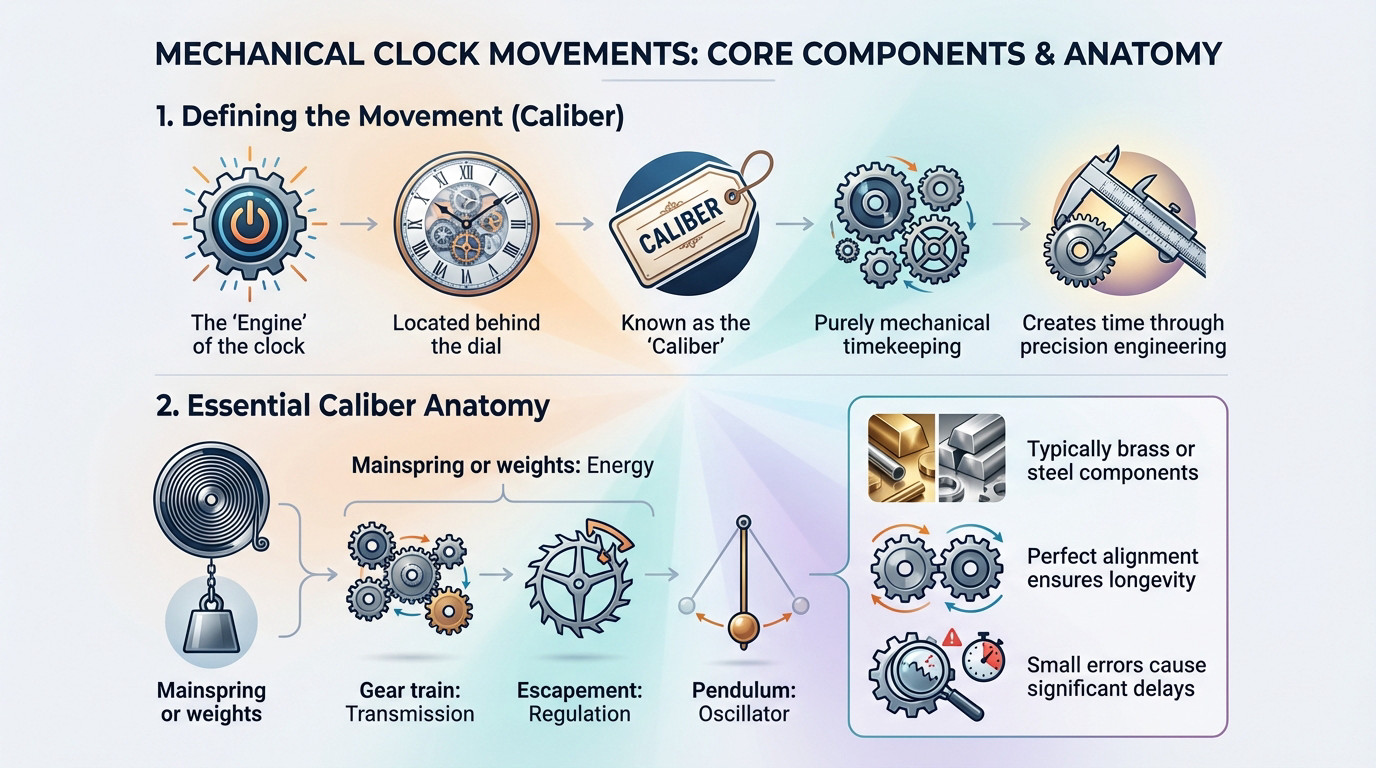
Defining the Movement Versus the Exterior
The movement acts as the relentless engine of your clock. It operates unseen behind the dial. The case merely serves as a protective shell.
Collectors refer to this internal mechanism as the caliber. It manages every second of timekeeping without a single electronic chip.
Forget the hands for a moment. We focus strictly on the internal gears.
While the dial displays the hour, the movement actually manufactures time. It stands as a genuine mechanical marvel. Precision engineering remains the absolute key here.
The Essential Anatomy of a Caliber
The mechanism relies on parts like the power source and escapement. Each element performs a specific, vital job. They function in a strict, linear sequence. Remove one, and the whole system fails immediately.
You can break down the anatomy into four distinct players. They drive the entire operation:
- Mainspring or weights (Energy)
- Gear train (Transmission)
- Escapement (Regulation)
- Pendulum (Oscillator)
Manufacturers forge these components from solid brass or hardened steel. They must sit in absolutely perfect alignment. This build allows the clock to run for years.
Every single gear tooth counts here. Small errors lead to big delays.
The Power Source: Springs vs. Weights
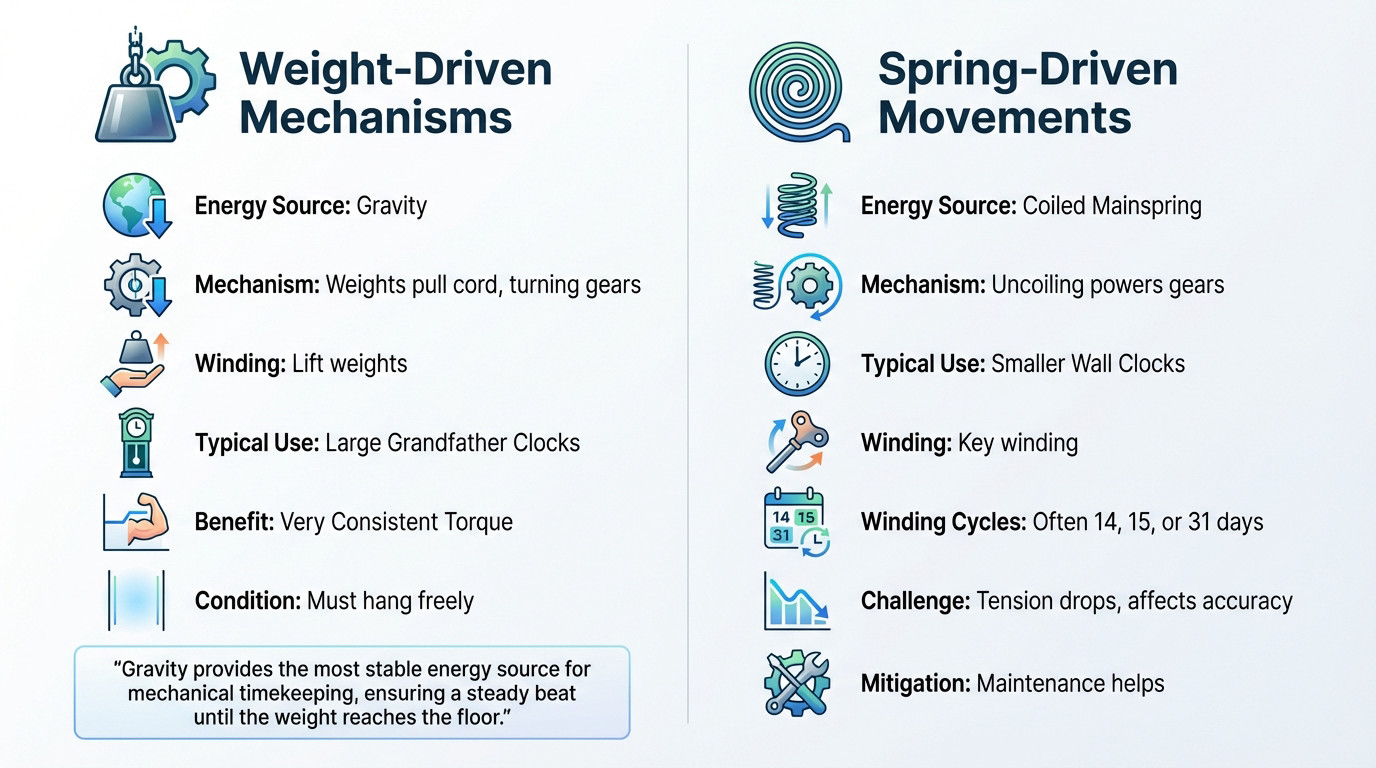
Now that we are inside the gears of how mechanical wall clocks actually work, let's look at what drives the mechanism: the energy source.
How Weight-Driven Mechanisms Generate Energy
Gravity acts as the primary fuel source here. Heavy cast iron weights pull down relentlessly on a sturdy cord. This unyielding, constant pull forces the first gear to rotate.
You wind it by manually lifting the heavy weights back up. It is a simple, yet brutally effective mechanical system. Large grandfather clocks almost exclusively rely on this gravity-fed method. It provides very consistent torque over time.
The weight must hang completely freely inside the case. Any physical obstructions will stop the clock.
Gravity provides the most stable energy source for mechanical timekeeping, ensuring a steady beat until the weight reaches the floor.
The Mechanics of Spring-Driven Movements
Smaller wall clocks often rely on a tightly coiled steel mainspring. Winding this spring stores a massive amount of potential energy. As it slowly uncoils, it drives the gears forward.
Manufacturers design these systems for specific durations. You will often see winding cycles of 14, 15, or 31 days depending on the model.
Unfortunately, spring tension inevitably drops as it unwinds. Regular maintenance helps manage this torque curve to keep time accurate.
Most spring-driven clocks require a specialized key. For collectors, this weekly winding becomes a cherished ritual.
The Transmission and Regulation System
Once energy is released, it needs to be controlled and distributed to the hands.
The Gear Train and Motion Work
The gear train is a series of wheels. It multiplies the slow movement of the barrel. This reaches the fast-moving escapement.
If you look inside the gears, the math is strict. You can check the visualization of gears to see the teeth count. This ratio dictates the speed. It is simple, unforgiving mechanical logic.
Motion work specifically handles the hands. It uses a reduction gear to separate hours and minutes.
Here is how the energy travels through the system. Each part plays a distinct role.
| Component | Function | Typical Material |
|---|---|---|
| Main Wheel | Transmits power from source | Brass |
| Center Wheel | Drives the minute hand | Brass |
| Third Wheel | Connects the gear train | Brass |
| Escape Wheel | Releases energy in steps | Steel |
The Escapement and Pendulum: Measuring Time
The escapement is the heart of the clock. It releases energy in tiny, equal bursts. This creates the famous tick-tock sound.
This action relies on the Graham escapement logic. It stops the wheels from spinning wild. The motion becomes regular and distinct. That is the real secret to keeping accurate time.
The pendulum regulates the speed. Gravity pulls it back to the center.
Adjusting the pendulum length changes the rate. Longer pendulums swing slower.
Maintenance and Fine-Tuning for Longevity
Adjusting the Beat and Cleaning
An "out of beat" clock sounds uneven like a limping heartbeat. It often stops unexpectedly after a few minutes. You must level the clock perfectly to fix this annoyance.
Dust is the enemy inside the gears where mechanical wall clocks actually work. Old oil turns into abrasive paste. This sludge wears down the pivot holes.
A full professional cleaning is needed roughly every five years. It keeps the movement running smoothly.
Never grab a can of WD-40. Only use specialized synthetic horological lubricants.
Common Troubleshooting for Beginners
If the clock stops, check the hands first. They might be touching each other, creating friction. Or they could be hitting the glass door when you close it.
Before calling a pro, run through this simple checklist to save money.
- Check if the clock is level
- Verify the weights are wound
- Look for tangled suspension springs
Sometimes the pendulum simply needs a gentle push to restart. Listen closely for a symmetrical beat, like a metronome. That is the sign of a healthy movement.
Be patient with these tiny adjustments. Small turns make surprisingly big differences.
Understanding a mechanical clock reveals a complex interplay between the power source, gear train, and escapement. Whether driven by weights or a mainspring, this system transforms raw energy into precise timekeeping. Thanks to innovations like the pendulum by Christiaan Huygens, these intricate movements remain enduring marvels of engineering.
FAQ
What distinguishes the movement from the case in a mechanical clock?
The movement, often referred to as the "caliber," is the internal engine of the clock responsible for measuring time. It comprises the gears, springs, and regulating organs that split energy into units like seconds, minutes, and hours. It is the active mechanism that lives behind the dial.
In contrast, the case is the external structure that houses and protects this mechanism. While it defines the clock's aesthetic, its primary technical role is to shield the delicate movement, dial, and hands from dust and physical damage.
How does the anchor escapement function within the mechanism?
The escapement acts as the critical control device between the energy source and the regulator (pendulum), releasing energy in precise, intermittent bursts. In an anchor escapement, a pivoting component with two pallets alternately locks and releases the teeth of the escape wheel.
This action delivers a regular impulse to the pendulum to keep it swinging and prevents the gears from unwinding uncontrollably. The physical contact between the pallets and the wheel teeth during this process creates the characteristic "tick-tock" sound.
What are the essential maintenance steps for a mechanical clock?
To ensure longevity, a mechanical movement typically requires lubrication every six years using specialized horological oil or high-quality synthetic oil applied to specific pivot points. It is crucial to never overfill the oilers or apply oil directly to the gear teeth, as this can attract dust.
Dust is a major enemy of mechanical clocks; when mixed with oil, it forms an abrasive paste that wears down the pivot holes. Therefore, maintenance also involves protecting the movement from dust and, if necessary, cleaning the mechanism with white spirit before re-oiling.
You May Also Enjoy
-
From labs to living rooms: why Nixie clocks captivate us ?
Nixie clocks merge vintage charm with modern technology, offering a warm, nostalgic glow that stands apart from digital screens. More than timekeepers, they are artistic relics of mid-century engineering, reconnecting us to tangible history in a digital age. Some models achieve 60-nanosecond precision, preserving authenticity with cutting-edge accuracy while maintaining the essence of craftsmanship.
-
How Wall Clock Mechanisms Convert Stored Energy into Time
The essential takeaway: Mechanical clocks convert stored energy from weights or springs into precise timekeeping via the escapement and gear train. The escapement’s regulated "tick-tock" controls energy release, while a 12:1 gear ratio synchronizes hour and minute hands. This understanding aids maintenance and reveals the timeless engineering behind every tick.