How Wall Clock Mechanisms Convert Stored Energy into Time
Mechanical clocks convert stored energy from weights or springs into precise timekeeping via the escapement and gear train. The escapement’s regulated "tick-tock" controls energy release, while a 12:1 gear ratio synchronizes hour and minute hands. This understanding aids maintenance and reveals the timeless engineering behind every tick.
Many people see their wall clock ticking away but have no idea how it actually works. The wall clock mechanism is a marvel of mechanical engineering, where energy from a wound spring or hanging weight is meticulously controlled to keep perfect time. This article explores the inner workings of the escapement, gear train, and oscillator, revealing how each component contributes to the clock's accuracy. Learn how gravity and springs drive the movement, why the escapement creates the iconic tick-tock sound, and how gears translate rapid motion into smooth hour and minute hand movement—all without electronics.
- The Power Source: Where the Motion Begins
- The Timekeeper's Pulse: The Escapement and Oscillator
- The Gear Train: Translating Pulses into Minutes and Hours
- Understanding Common Mechanical Clock Issues
- The complete mechanical journey: from stored energy to telling time
The Power Source: Where the Motion Begins
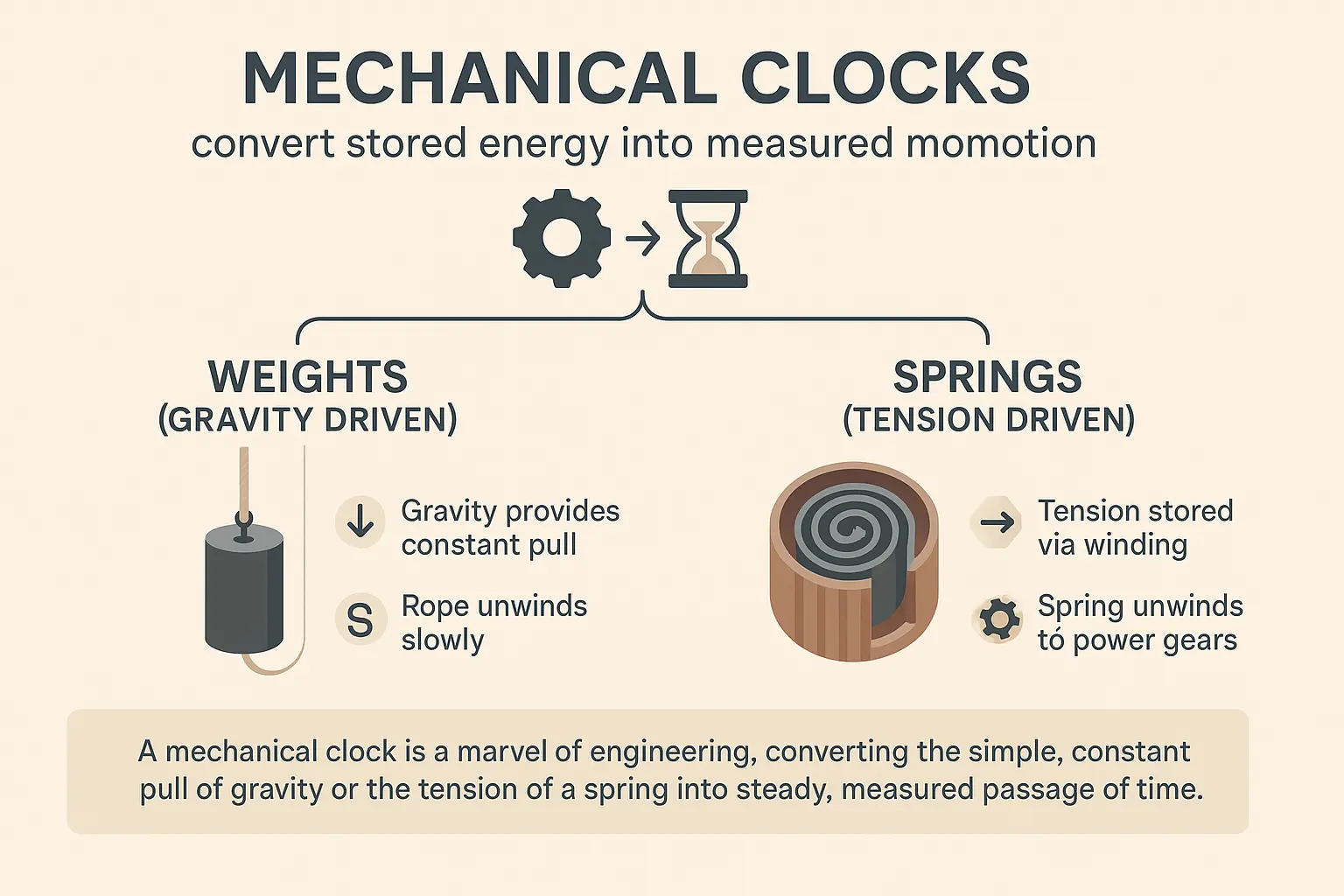
Mechanical wall clocks use stored energy from weights or springs, not electricity. They rely entirely on mechanical components for timekeeping.
The Two Classic Methods: Weights and Springs
Weights harness gravity; springs use tension. Grandfather clocks use descending weights via chains for steady torque. Mainsprings store energy when wound, driving gears over 24-48 hours. Common in smaller wall clocks.
A mechanical clock converts gravity or spring tension into steady time passage.
The escapement regulates energy release: each pendulum swing releases one escape wheel tooth, controlling gear train speed for accurate hand movement. This precise control prevents free-spinning and ensures steady operation.
A 1-meter pendulum swings once per second for precision. Balance wheels with hairsprings replace pendulums in compact clocks for consistent motion.
Weight Advantages:
- Consistent power delivery ensures high accuracy in regulators
- 700g weight powers clock for seven days without rewinding
- Used in high-end movements like Hermle for reliability
Weight Disadvantages:
- Requires significant vertical space
- Higher production and shipping costs
- Incorrect weight damages movement or causes timing errors
Spring Advantages:
- Compact design fits wall clocks and mantel pieces
- Lower manufacturing costs make them affordable
- Easy winding requires minimal maintenance
Spring Disadvantages:
- Torque decreases as it unwinds, often needing a fusee for consistency
- Accuracy may vary without compensation
- Historically less precise than weight-driven clocks
The Timekeeper's Pulse: The Escapement and Oscillator
The Role of the Oscillator: Creating a Steady Beat
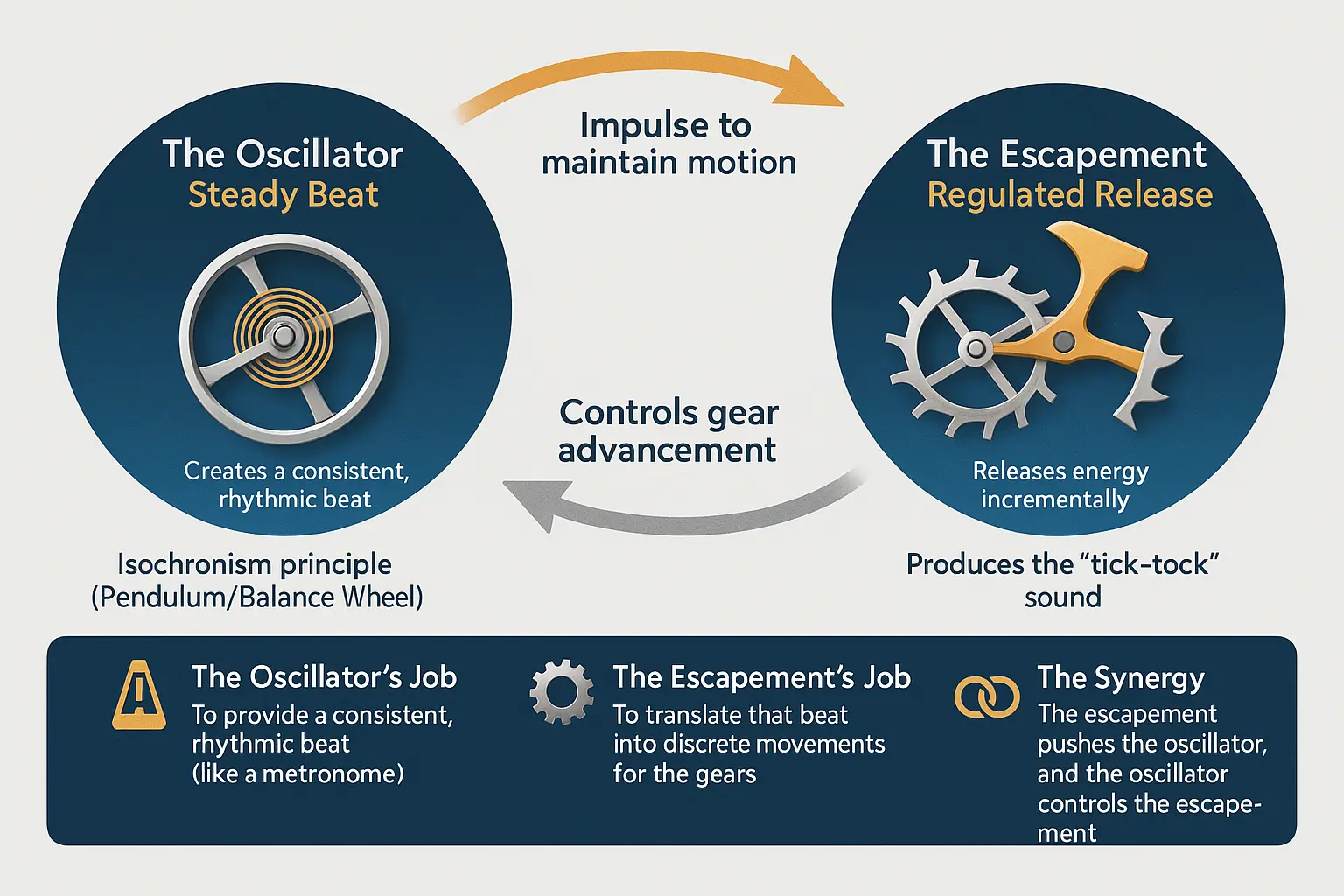
The oscillator is the heart of mechanical clocks. It creates a steady rhythm that ensures accurate timekeeping. Without it, energy would release uncontrollably. Its consistent beat drives the entire mechanism.
Pendulums rely on length for consistent swing periods. Galileo discovered this property. Small amplitudes (4-6 degrees) ensure isochronism. This makes pendulums reliable timekeepers.
Balance wheels use spiral springs for compact designs. Robert Hooke and Christiaan Huygens developed this in 1657. They oscillate at fixed frequencies, regulating gear movement precisely.
The spiral spring's elasticity determines the balance wheel's oscillation rate. Material advancements like Nivarox and silicon improve resistance to temperature and magnetism.
True isochronism requires precise amplitude control. Huygens' cycloidal cheeks were an early fix. Modern escapements like the anchor design limit swing to 4-6 degrees. This ensures consistent timing for accurate timekeeping.
The balance wheel's oscillation frequency is typically 2.5 to 5 Hz. This rate is carefully calibrated to match the escapement's design. Precise tuning ensures minimal timekeeping errors.
The Escapement: Releasing Energy Tick by Tock
The escapement controls energy release. It translates oscillator motion into gear movement. Each swing allows gears to advance. This creates the familiar 'tic-tac' sound.
This mechanism has two key roles. First, it gives small impulses to the oscillator, countering friction. Second, it permits gears to move incrementally. This ensures precise time display.
Modern escapements like the lever type minimize contact with the oscillator. This 'detached' design allows freer oscillation, improving accuracy. High-end chronometers use advanced escapements for superior performance.
The 'tic-tac' sound comes from the escapement wheel teeth interacting with the lever. Each engagement releases energy and advances gears by a precise increment.
Early escapements like the verge caused significant friction. Improvements like the Graham escapement (1721) eliminated recoil, enhancing precision. Today's designs minimize contact for maximum accuracy.
Rubies reduce friction at contact points. Regular maintenance prevents oil degradation, ensuring the escapement operates smoothly for years.
- The Oscillator's Job: To provide a consistent, rhythmic beat (like a metronome).
- The Escapement's Job: To translate that beat into discrete movements for the gears.
- The Synergy: The escapement pushes the oscillator to keep it moving, and the oscillator controls how often the escapement lets the gears turn.
The Gear Train: Translating Pulses into Minutes and Hours
The gear train converts escapement pulses into smooth motion. Gears reduce mainspring or weight energy into precise hand rotations. Mainspring stores energy when wound, releasing it gradually. Escapement regulates ticks via pendulum/balance wheel. Minute hand hourly; hour hand every 12 hours. Precision ensures accuracy—any inconsistency causes errors.
From Fast to Slow: The Role of the Wheel Train
Wheel train transfers energy via interconnected gears. Each stage reduces speed incrementally. Fourth wheel rotates once per second; center wheel once per hour. Escapement interacts every 2-3 seconds, ensuring consistent energy flow for accurate timekeeping.
The Motion Work: Connecting the Hours and Minutes
Motion work beneath the dial uses cannon pinion and minute wheel to create a 12:1 ratio. Hour hand advances once per 12 minute rotations. Cannon pinion enables manual adjustment without disrupting the gear train.
| Component | Primary Function | Typical Rotation Speed |
|---|---|---|
| Power Source | Stores energy | N/A |
| Escapement Wheel | Regulates energy release | 2-3 seconds |
| Center Wheel | Drives minute hand | 1/hour |
| Motion Work | 12:1 ratio for hour hand | 1/12 hours |
| Hands & Dial | Displays time | Min:1/hour; Hour:1/12h |
Precision engineering ensures harmony. Gears are crafted and lubricated to minimize friction, enabling weeks of reliable operation. These mechanisms remain a timeless feat of analog engineering.
Understanding Common Mechanical Clock Issues
The Importance of Position and Stability
Proper positioning is vital for mechanical clocks. The pendulum's swing regulates the escapement, converting stored energy into motion. If the clock is tilted, the pendulum moves unevenly. This disrupts the escapement's function, leading to inconsistent timekeeping or complete stoppage.
A level surface ensures the pendulum swings symmetrically. Even a slight angle causes irregular "tick-tock" sounds. This imbalance prevents the gears from moving smoothly. Stability directly impacts accuracy and reliability. Issues like a clock that only works when laid flat often stem from escapement misalignment.
Many clock owners overlook leveling. A tilted clock may run for a while before stopping. Correct positioning restores smooth operation. Always check this first before troubleshooting other issues. It's a common but easily fixable problem.
When Your Clock Stops Ticking: Basic Troubleshooting
First, check if the clock is fully wound. Ensure it's perfectly level using a bubble level. Misalignment often causes stopping due to uneven pendulum motion. Proper leveling is critical for accurate timekeeping.
Confirm the pendulum swings freely without obstructions. Dust or old oil creates friction, halting the mechanism. Regular cleaning maintains smooth operation and prevents stoppages. Check for any physical blockages.
Inspect the weights or mainspring. Ensure they're correctly attached and not tangled. Worn parts or misaligned components can halt the movement. Address these issues promptly to avoid further damage.
Often, a mechanical clock's refusal to run is not a sign of a broken part, but simply a need for winding, leveling, or a professional cleaning to restore its rhythm.
If issues persist, professional servicing may be required. Internal wear or component damage needs expert attention. Ignoring these signs can lead to permanent damage. Don't delay maintenance for your cherished timepiece.
The complete mechanical journey: from stored energy to telling time
A symphony of gears and gravity
The energy source—either a wound spring or descending weights—stores potential energy. This energy moves through the gear train, which reduces speed. The escapement, working with a pendulum or balance wheel, releases energy in exact intervals. Each swing of the pendulum controls the escapement's release. This creates the iconic tick-tock sound. Without this regulation, the clock would run too fast or stop. The gear train acts like a car's transmission, converting high-speed rotation into precise hand movement. Each component works in harmony for perfect timekeeping. Mechanical clocks have been trusted for centuries due to their reliability and elegance.
The enduring appeal of the mechanical clock
The enduring appeal of the mechanical clock lies in its timeless craftsmanship. These intricate mechanisms are not just tools but historical engineering marvels. Understanding their function deepens appreciation for their artistry and precision. They represent human ingenuity at its finest. Their operation is a beautiful dance of physics and engineering. They continue to inspire awe and admiration today.
- Energy Storage: A weight or spring holds potential energy.
- Energy Release: The escapement releases energy in precise intervals.
- Speed Reduction: Gears slow motion for accurate hand movement.
- Time Display: Final gears turn hands to show correct time.
While quartz and atomic clocks dominate today, mechanical wall clocks continue to captivate. Their intricate gears and pendulums transform stored energy into precise timekeeping—a testament to centuries of craftsmanship and human ingenuity. The enduring appeal of these timepieces lies in their mechanical artistry.
FAQ
Can a wall clock mechanism be replaced?
Yes, replacing a wall clock mechanism is often straightforward, especially for quartz models. Most modern wall clocks use standard movements that can be swapped out with minimal tools.
For mechanical clocks, the process can be more complex due to intricate gears and springs. Always ensure compatibility with your clock's dial thickness, hand style, and shaft length before purchasing a replacement. If unsure, consult a professional clock repair service for assistance.
How do I know the correct size for a clock mechanism?
To determine the correct size, measure the clock's shaft length from the front of the dial to the end of the shaft. Also check the shaft diameter and dial thickness. Most replacement mechanisms list these measurements.
Additionally, ensure the hands fit properly—minute hands should be long enough to reach the hour markers without interference. If your clock has a second hand, verify the mechanism supports it. Refer to the manufacturer's specifications or consult a professional if measurements are unclear.
Why do clock mechanisms stop working?
Clock mechanisms often stop due to several common issues. For quartz clocks, dead batteries or electrical faults are frequent causes. Mechanical clocks may stop from insufficient winding, dirt accumulation in gears, or misalignment of the escapement.
Pendulum clocks require precise leveling; even a slight tilt can disrupt the swing. Additionally, worn-out parts or dried lubricants in older mechanical movements can cause friction, leading to stops. Regular maintenance and proper installation are key to preventing these issues.
What are common issues with clock malfunctions?
Common malfunctions include erratic ticking or no ticking at all, hands moving incorrectly (e.g., too fast/slow), or hands not moving despite the mechanism running. Other issues involve the clock stopping intermittently, which often relates to battery issues (quartz) or misalignment (mechanical).
For pendulum clocks, the "beat" may be off, causing the clock to stop after a few swings. Aged lubricants, bent hands, or dirt buildup in the movement are typical culprits behind these problems.
Is it worthwhile to fix a wall clock?
Whether to fix a wall clock depends on its value and sentimental significance. Antiques or heirloom pieces often justify professional repair, as replacement costs may be lower than replacing the entire clock.
However, for inexpensive quartz clocks, the cost of repair (e.g., $20 for a new movement) might be comparable to buying a new one. Consider the clock's emotional or historical value—sometimes, the effort to restore a cherished piece outweighs the financial cost.
How much does replacing a clock mechanism cost?
The cost varies by clock type. Quartz movements typically range from $10 to $30 for parts, with DIY replacement being affordable. Professional installation might add $20-$50.
Mechanical clocks are more expensive; a basic movement could cost $50-$150, while intricate antique repairs may exceed $200. Always factor in labor costs if you're not doing it yourself. For high-end or vintage clocks, specialized services will increase the price.
Is it safe to move clock hands backward?
For most modern quartz clocks, moving the hands backward is generally safe. However, mechanical clocks with date complications or intricate gear systems should only have hands moved forward to avoid damaging internal components.
Always check the manufacturer's guidelines—some antique or specialized clocks may not tolerate backward movement. If unsure, gently move the hands forward in small increments to set the time.
How do I measure for a replacement clock mechanism?
Measure the shaft length from the front of the dial to the back of the movement. Also note the shaft diameter, typically measured in millimeters. Check the dial thickness to ensure the movement's mounting hardware fits.
For hands compatibility, verify the hole sizes in the minute and hour hands match the movement's shafts. If the clock has a second hand, confirm the mechanism has a second hand post. Taking precise measurements ensures a seamless replacement.
How can I identify a clock mechanism?
Identify the mechanism by checking for manufacturer logos, model numbers, or part numbers on the movement itself. Look for labels or engravings on the back or sides.
Determine if it's quartz (battery-powered) or mechanical (wind-up). Note the shaft specifications, hand compatibility, and any additional features like chimes or date functions. If no markings are present, compare measurements to known models or consult a clock repair specialist for identification.
You May Also Enjoy
-
From labs to living rooms: why Nixie clocks captivate us ?
Nixie clocks merge vintage charm with modern technology, offering a warm, nostalgic glow that stands apart from digital screens. More than timekeepers, they are artistic relics of mid-century engineering, reconnecting us to tangible history in a digital age. Some models achieve 60-nanosecond precision, preserving authenticity with cutting-edge accuracy while maintaining the essence of craftsmanship.