Buying a nixie tube clock in 2026: what to check before you commit
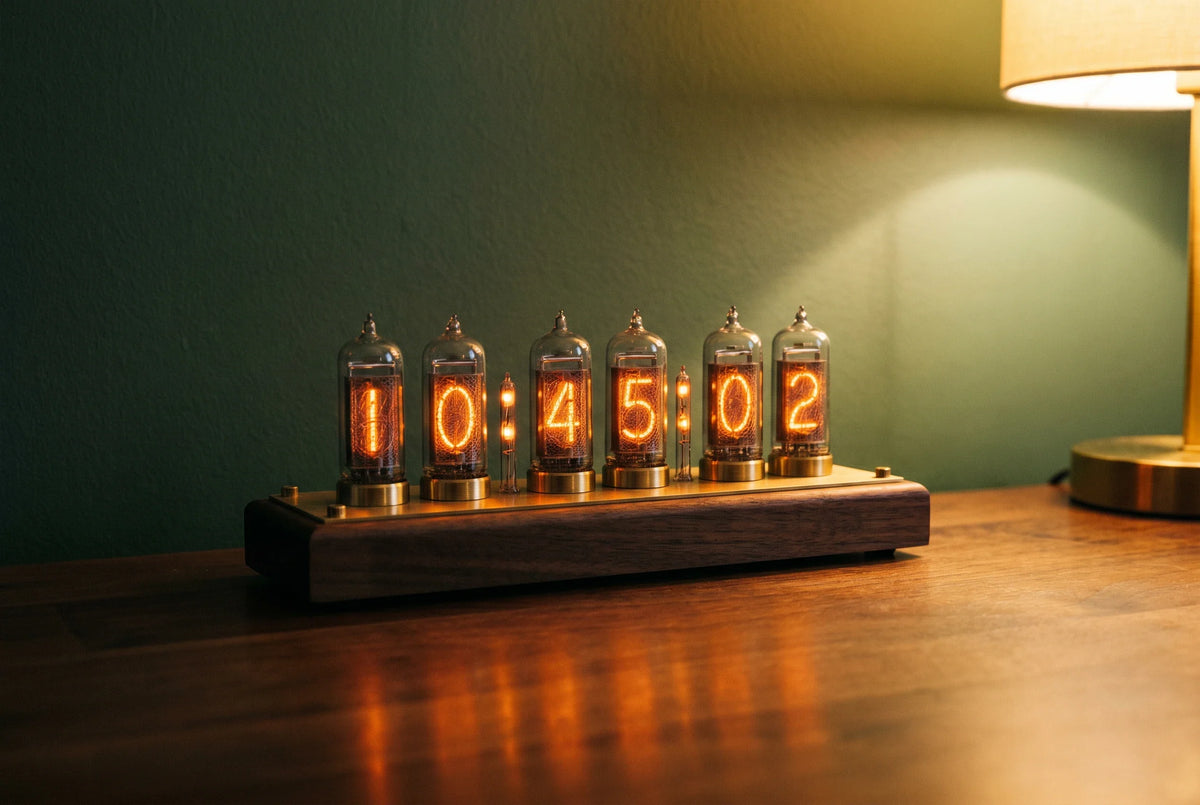
A nixie tube clock is part timepiece, part archaeology. The tubes themselves stopped being mass-produced in the early 1990s, and every clock now sold uses either NOS (new old stock) tubes from that era or, more recently, new-production tubes from a handful of small manufacturers. The technology has been covered in depth elsewhere in this magazine, see how nixie clocks work and why nixie clocks captivate. This piece focuses on what to verify before buying one.
Where the tubes come from
Three tube sources exist on the market today:
NOS Soviet tubes (IN-12, IN-14, IN-18) made between 1965 and 1991 in factories like Reflektor in Saratov. These are the most authentic and the most variable in quality. Tested NOS tubes are the standard for serious clocks; untested NOS is a gamble.
NOS Western tubes (Burroughs B-5750, GE 8421, RCA Nixie series). Rare, expensive, often only found in collector circles. Used mostly in restoration projects rather than new clocks.
New-production tubes, primarily the Dalibor Farny Z568M and successors. These are made one tube at a time in small workshops and represent the future of the format. Build quality is higher than vintage NOS, but the cost per tube reflects it.
What separates a $200 nixie clock from a $2,000 one
Three things, mostly: tube source, driver board design, and case craftsmanship. The cheapest nixie clocks pair untested Soviet NOS with a generic Chinese driver board and a budget acrylic case. They work, for a while. The driver boards in particular are where corner-cutting bites: poorly designed driver circuits run tubes at the wrong voltage or duty cycle and cut tube life from decades to a few years.
Premium nixie clocks invest in custom driver boards with proper anti-cathode-poisoning routines (each digit gets cycled regularly to prevent uneven cathode wear), GPS or WWVB sync, and machined wood or metal cases. Browse our nixie tube clocks collection for the current range.
Specifications worth verifying
, Tube type and source. Get this in writing. "NOS Russian IN-14, tested" is the minimum acceptable detail.
, Cathode-poisoning prevention. Look for terms like slot machine effect, cathode protection cycle, or digit rotation in the spec sheet.
, Replacement tube availability. If the clock uses a rare tube type, replacement may be impossible in five years.
, Power supply. Quality clocks ship with a regulated DC adapter. Bare 9V wall warts are a warning sign.
, Sound. Some nixie driver boards emit a faint high-pitched whine. Ask before buying.
, Warm-up. A few seconds of irregular display on power-up is normal. Persistent flicker is not.
How a nixie clock fits a room
The orange glow of a nixie tube is unmistakable, and at full brightness, it dominates a darkened room. Most quality clocks include a brightness sensor that dims tubes in low light. Plan placement accordingly: a nixie clock on a bedside table needs that auto-dim feature; one in a living room or study can run at full brightness without disturbance.
The aesthetic register sits between mid-century industrial and steampunk. Nixie clocks pair particularly well with leather, walnut, brass, and matte black. For a coherent material conversation, our wooden desk clocks work alongside nixie clocks in the same space.
What you are really buying
A nixie tube clock is the rare object that combines genuinely obsolete technology, current craftsmanship, and an orange light that no LED has ever truly imitated. Owning one is closer to owning a vintage watch than owning a clock: the value is in the mechanism as much as the function. For a wider view of where standalone timepieces sit in 2026 interiors, see our wall clock trends 2026 piece.