Cuckoo clocks: From Black Forest heritage to modern design
The VdS certificate remains the sole guarantee of an authentic Black Forest cuckoo clock, preserving 300 years of German tradition. Deciding between mechanical 1-day or 8-day movements and maintenance-free quartz options allows for matching this historic artistry with specific lifestyle requirements, ensuring the acquisition of a genuine, lasting masterpiece.
Distinguishing a genuine masterpiece from a cheap imitation is a common frustration for decor enthusiasts. This guide explores the evolution of cuckoo clocks, linking their traditional Black Forest heritage to sleek modern designs. You will learn to identify VdS certification and select the perfect movement to ensure your timepiece remains a valuable asset.
- Understanding Traditional Black Forest Cuckoo Clocks
- Mechanical vs Quartz: Choosing Your Movement
- Styles and Designs: From Chalet to Modern
- Installation and Maintenance Guide
Understanding Traditional Black Forest Cuckoo Clocks
You might look at Cuckoo Clocks: From Black Forest Tradition to Modern Design Icon and see just a timepiece, but you'd be missing the point entirely. It is a slice of German soul that ticks.
The Rich Heritage of Schoenwald and Beyond
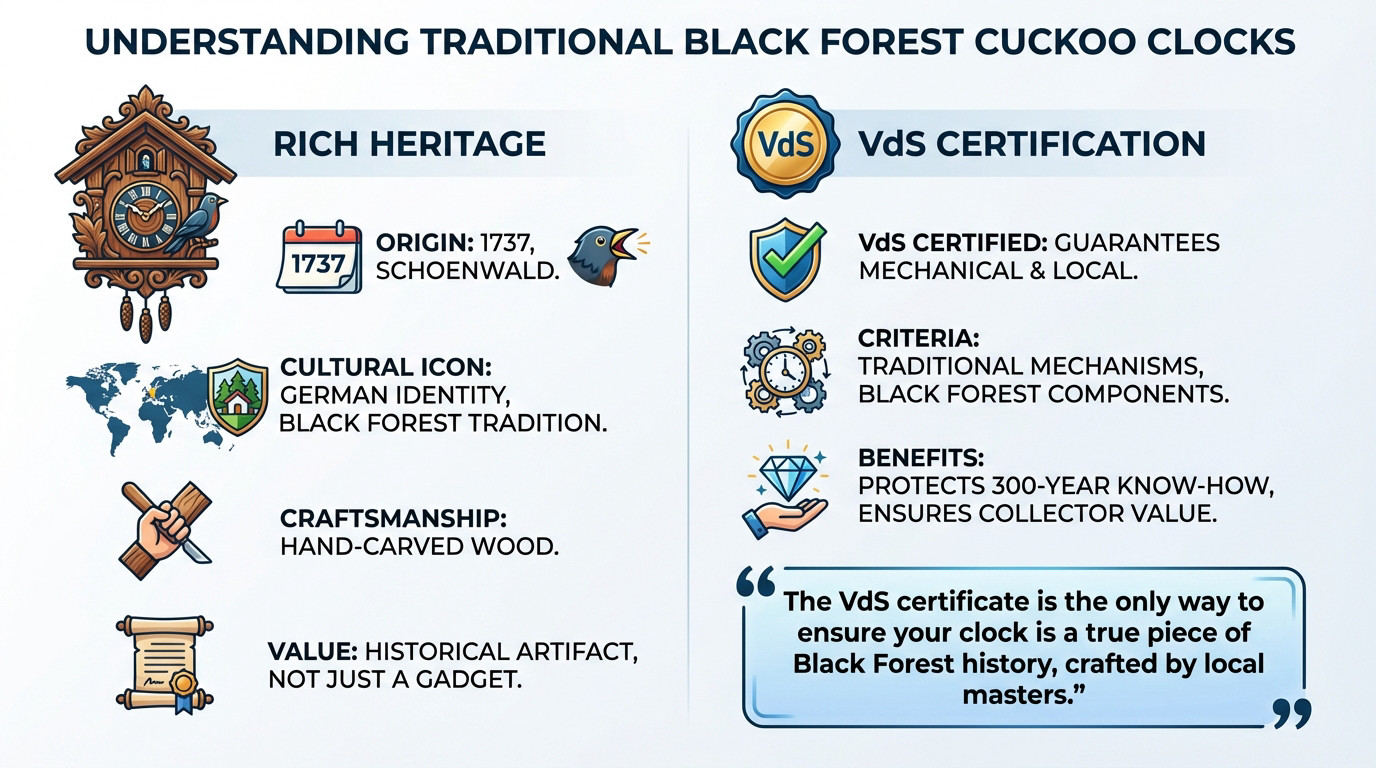
It started around 1737 with Franz Anton Ketterer's genius. The cuckoo was invented in Schoenwald, establishing a massive shift. That moment birthed a centuries-old tradition.
These pieces are the heartbeat of the Black Forest. They represent a deep, unshakeable German identity known worldwide. Masters spend hours so the hand-carved nature of the wood is flawless. It is art, not manufacturing.
Forget cheap gadgets; these are genuine historical artifacts. You are buying a legacy.
The VdS Certificate of Authenticity
Look for the VdS certification seal before you buy. It guarantees the movement is mechanical and locally made. Without it, you aren't getting authentic cuckoo clocks.
The standards are incredibly strict for every single maker. Mechanisms must remain traditional to the core. Every key component must come from the Black Forest region specifically.
This matters because it protects 300-year-old know-how from extinction. It secures long-term value for serious collectors. You don't want a knock-off; you want the real deal.
The VdS certificate is the only way to ensure your clock is a true piece of Black Forest history, crafted by local masters.
Mechanical vs Quartz: Choosing Your Movement
We have covered the history, but now you face a practical decision regarding the internal heart of the piece. To truly understand Cuckoo Clocks: From Black Forest Tradition to Modern Design Icon, you must choose between tradition and ease.
The Magic of Mechanical Movements: 1-Day vs 8-Day
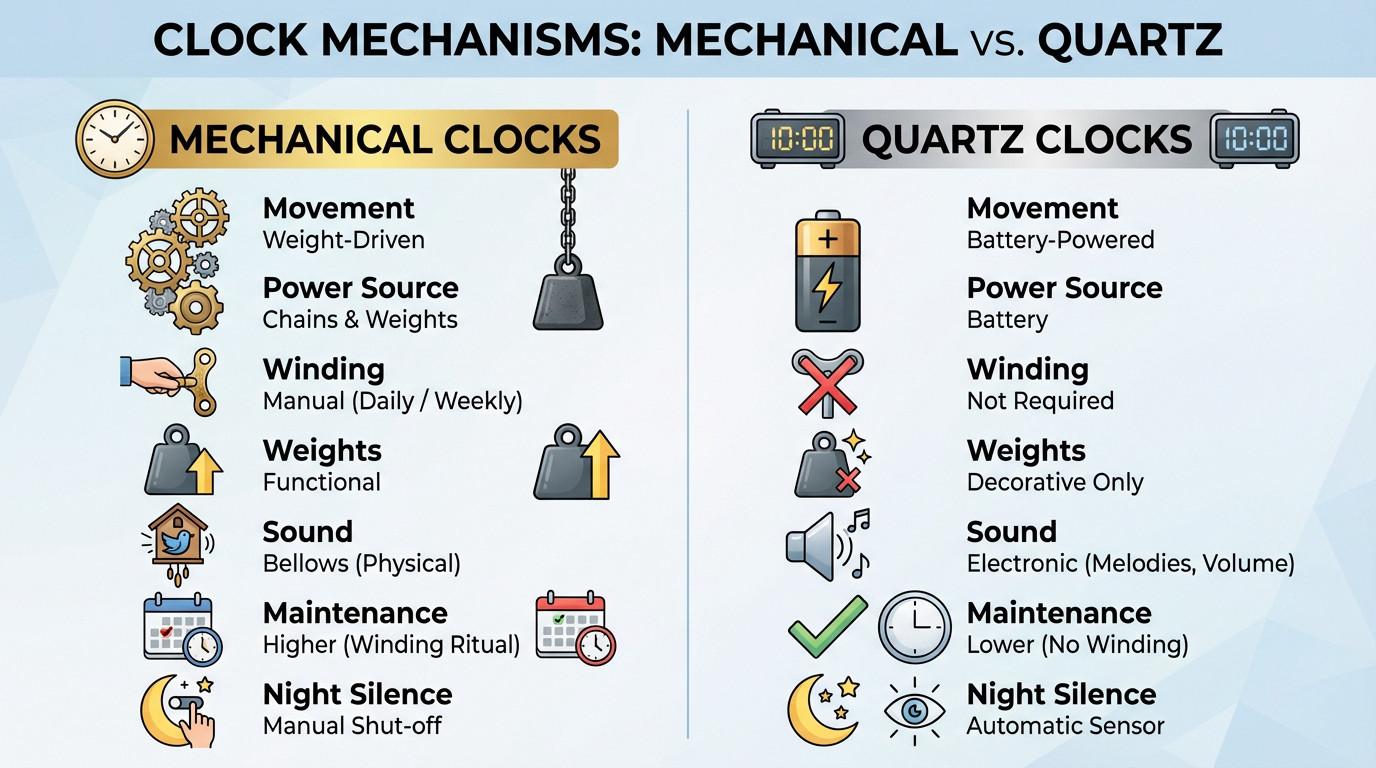
Authentic mechanical cuckoo clocks rely on gravity, not electricity. Heavy iron pine cones hang from chains, physically pulling the gears to drive the time. It is engineering you can feel.
You must choose your commitment level carefully. The 1-day model demands attention every single day, whereas the 8-day version runs for a full week. I consider the winding process a grounding ritual, not a chore.
Then there is the sound itself. Air pushes through two wooden bellows to create the call. It is a purely physical, non-electronic experience that digital speakers simply cannot replicate.
- 1-day: requires daily attention, lighter weights
- 8-day: weekly winding, heavier weights, more convenience
- Both: require manual night shut-off options
The Convenience of Modern Quartz Technology
Perhaps you prefer a maintenance-free existence. Quartz models run on batteries, meaning the weights are strictly decorative here.
These are ideal for busy people who might forget to wind a clock. You get the visual charm, plus automatic light sensors that silence the bird.
Do not dismiss them as fake. Quartz clocks still look traditional. They offer distinct advantages like multiple melodies and adjustable volume controls, giving you the aesthetic without the daily obligation.
Styles and Designs: From Chalet to Modern
Classic Chalet and Carved Masterpieces
The Chalet style features scenes of alpine life. Think beer drinkers and moving wood choppers. These animated figures represent the evolution of Cuckoo Clocks: From Black Forest Tradition to Modern Design Icon.
Focus on Carved (Traditional) designs. These highlight nature and hunting. Look for intricate leaf patterns and wildlife figures like deer or birds. Makers like Anton Schneider excel at these detailed, hand-crafted wooden structures.
Mention the Shield clocks, originating in the 18th century. These are the oldest painted styles. They offer a vintage, colorful look.
Finally, discuss the "Clock of the Year". This prestigious VdS award celebrates the most stunning annual designs from the region.
| Style | Key Features | Best For |
|---|---|---|
| Chalet | Moving figurines | Storytelling |
| Carved | Hand-carved animals | Nature Lovers |
| Modern | Minimalist lines | Urban Spaces |
| Shield | Painted faces | History Buffs |
The Rise of Contemporary and Modern Designs
Explore modern cuckoo clocks. They use bold colors and clean lines. They fit perfectly in urban apartments. You get the heritage without the visual weight of heavy dark wood.
Explain how they keep tradition. The bird still pops out on the hour. The craftsmanship remains high quality, often with VdS certification. It is not a cheap souvenir; it’s a minimalist take on a classic icon for today.
Mention materials. Some use metal or plastic for a sleek look. Others stick to wood but with neon finishes. It’s about personal expression and breaking the old rules.
Installation and Maintenance Guide
After picking the perfect clock, you need to know how to keep it ticking for decades.
Setting Up Your Clock for the First Time
Start by removing the wire holding the chains. If you yank them, you break the magic. Make sure the pendulum hangs freely without hitting anything inside the case.
Next, mount it on a sturdy screw, not a nail. Here is the trick: the clock must be perfectly level. If it tilts, the beat becomes irregular and stops.
To set the time, turn the minute hand clockwise. Never touch the hour hand directly; you will damage the mechanism. Listen to the strike to confirm the hour matches.
A cuckoo clock is a living machine; treat the chains with care and it will sing for generations.
Long-term Care and Global Support
Dust destroys precision. Use a soft brush to clean the carvings gently. Never use harsh chemicals or damp cloths on the wood, as moisture warps the casing over time.
Mechanical clocks need oil every three to five years. Don't do this yourself. Top manufacturers offer worldwide support and warranties. Use their global repair networks to protect your investment in Cuckoo Clocks: From Black Forest Tradition to Modern Design Icon.
Finally, stick to original spare parts like bellows and weights. Using generic replacements kills the authenticity. Keeping it original preserves the value and the soul of the piece.
Whether selecting a traditional mechanical masterpiece or a convenient quartz model, a Black Forest cuckoo clock represents centuries of authentic German craftsmanship. With diverse styles ranging from classic carved designs to modern interpretations, these VdS-certified timepieces bring the unique charm of the Schwarzwald.
FAQ
When was the cuckoo clock invented in Schoenwald?
While popular folklore often attributes the invention to master clockmaker Franz Anton Ketterer in the 1730s, historical analysis suggests the concept likely originated in Bohemia before being adopted in the Black Forest. However, the region became the true home of the craft in the mid-18th century, where local masters refined the mechanism and popularized the traditional carved style we recognize today.
What are the criteria for VdS Black Forest cuckoo clock certification?
To earn the VdS (Verein die Schwarzwalduhr) certificate of authenticity, a clock must be manufactured exclusively within the Black Forest region using essential locally produced components. Crucially, the movement must be purely mechanical; quartz or solar-powered clocks do not qualify, ensuring that every certified piece represents authentic, traditional craftsmanship.
What is the fundamental difference between 1-day and 8-day cuckoo clock movements?
The primary difference lies in the winding frequency required to keep the clock running. A 1-day movement runs for approximately 24 hours and requires you to pull the chains daily, creating a consistent ritual. In contrast, an 8-day movement offers greater convenience by running for a full week on a single wind, utilizing a more complex gear system and heavier weights.
How do cost and complexity differ between 1-day and 8-day mechanisms?
Due to the sophisticated engineering required to run for a week, 8-day clocks are generally 20% to 40% more expensive than their 1-day counterparts. They feature additional gears and require significantly heavier cast iron weights to store energy, whereas 1-day models utilize a simpler construction with lighter weights, making them more affordable and easier to manufacture.
What distinguishes the Chalet style from the Shield style?
Chalet style is the most globally recognized design, featuring detailed carvings of Alpine houses often accompanied by animated scenes of daily life. The Shield style (Schilderuhr), however, represents an older vintage tradition characterized by a simple, hand-painted square wooden face topped with a decorative semicircle, offering a more understated and historical aesthetic.
What are the current design trends for modern cuckoo clocks?
Modern designs reinterpret the Black Forest tradition through minimalist lines, geometric shapes like cubes or pyramids, and bold colors such as neon, black, or white. Manufacturers like Rombach & Haas are also exploring new materials like bamboo and innovative "free bird" designs where the cuckoo is visible outside the case, blending ancestral mechanics with contemporary art.
You May Also Enjoy
-
Why Clocks Show 10:10: The Marketing Tradition
Clocks set to 10:10 are a strategic marketing choice for visual harmony and psychological impact. The hands form a 'smile', enhancing brand appeal. A 2017 study confirmed this setting significantly boosts purchase intent. This standard ensures logos and complications remain visible, with its influence now extending to AI-generated images.
-
The history of wall clocks: from sun to design
Wall clocks evolved from crude ancient tools into precise instruments through Christiaan Huygens’s pivotal 1656 pendulum invention. This breakthrough shifted timekeeping from public towers to private homes, eventually allowing functionality to merge with art during the Mid-Century Modern era. Consequently, these objects now stand as enduring symbols of both engineering mastery and interior design.
-
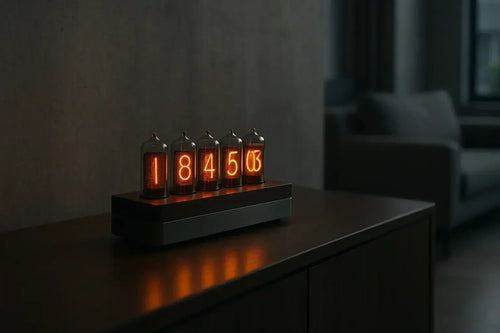
Modern Nixie clocks: vintage tech meets contemporary design
Nixie clocks merge Cold War-era technology with contemporary design, creating a warm, nostalgic glow that transforms any space into a statement piece. These artisanal timepieces offer unique visual appeal, Wi-Fi sync, and adjustable backlighting, making them both functional and collectible.