
How to regulate a pendulum clock?
The essential takeaway: Pendulum accuracy relies entirely on length, meaning raising the bob accelerates the clock while lowering it slows the rhythm. Mastering the regulation nut allows for precise speed control, eliminating frustration and guesswork. Since one full turn typically alters time by one to two minutes daily, achieving perfect timekeeping demands methodical twenty-four-hour observation cycles.
Is the rhythmic heartbeat of your cherished timepiece constantly overshadowed by the annoyance of losing minutes, leaving you desperate to learn exactly how to regulate a pendulum clock without calling a repairman? Instead of gambling with random twists of the nut, this guide utilizes simple physics to explain why leveling and temperature matter before you even touch the mechanism. By mastering the systematic "one-turn test" to determine your clock's unique adjustment ratio, you will finally eliminate the guesswork and restore the reliable, precise timekeeping your heirloom was built to deliver.
- Before You Touch Anything: The Fundamentals of Pendulum Timekeeping
- The Basic Regulation: Adjusting Your Clock's Speed
- From Guesswork to Precision: Finding Your Clock's 'Time Equation'
- Fixing the Heartbeat: How to Put Your Clock 'In Beat'
- When Regulation Fails: Troubleshooting Deeper Issues
Before You Touch Anything: The Fundamentals of Pendulum Timekeeping
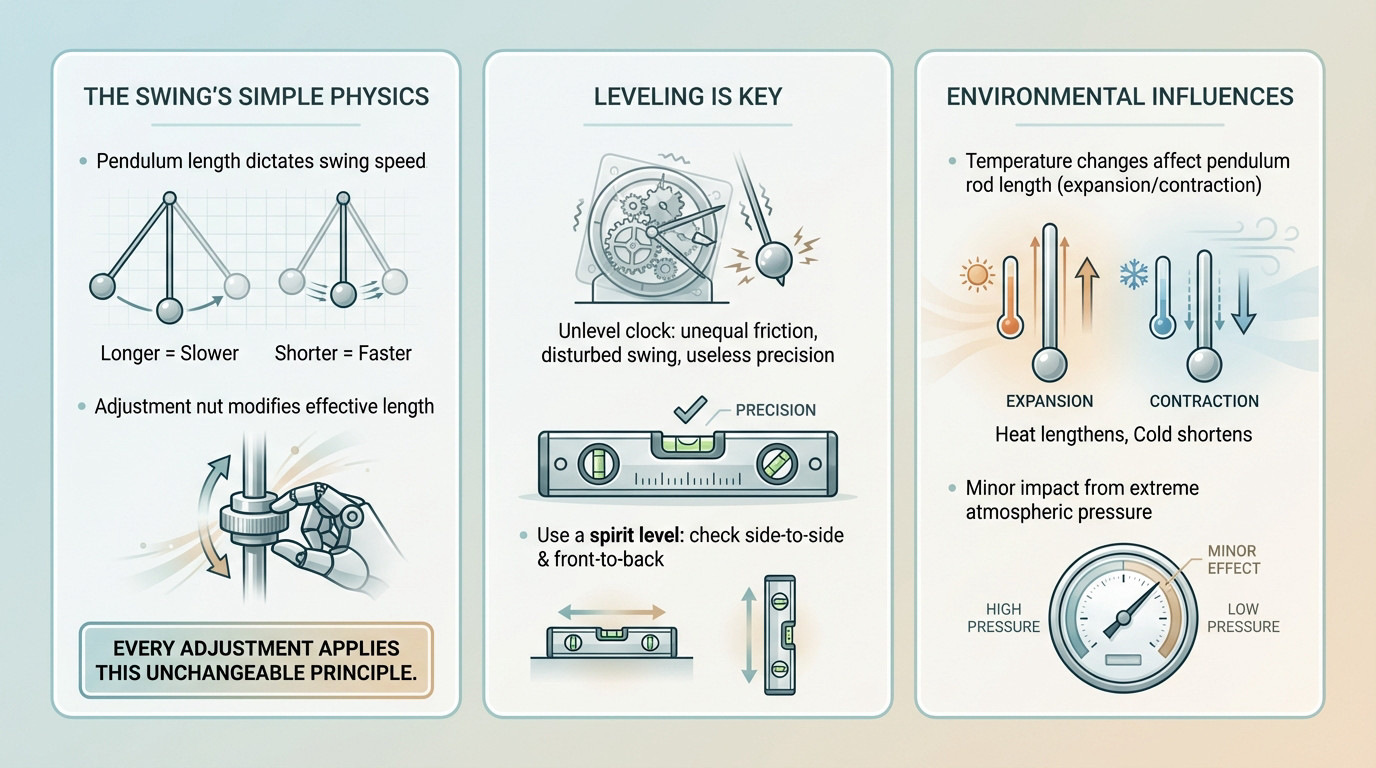
The Simple Physics Behind the Swing
Physics here is brutally simple: length dictates speed. A long pendulum drags, while a short one hurries. That is the only law determining how to regulate a pendulum clock.
That brass adjustment nut isn't magic. It just moves the bob up or down to change the effective length. You are literally fighting gravity with a screw.
Why Your Clock Must Be Perfectly Level
An off-kilter clock forces the delicate escapement to limp painfully. It creates uneven friction that destroys the natural beat. The mechanism effectively fights itself every second. Precision becomes totally impossible when the foundation is crooked.
Stop guessing and grab a spirit level. Check the case from left to right, then front to back. This step is absolutely non-negotiable for accurate timekeeping.
Environmental Factors You Can't Ignore
Temperature changes are the silent killers of accuracy. Metal expands in summer heat and shrinks in winter cold. This physical shifting messes with the pendulum's length without you touching it.
Extreme atmospheric pressure shifts also play a minor role. The air density changes the resistance against the swing. Don't panic, just realize nature affects your machine.
The Basic Regulation: Adjusting Your Clock's Speed
With the groundwork laid, it’s time to get your hands dirty. Here is the concrete method to adjust your clock’s speed, step by step.
Finding Your Reference and Measuring the Error
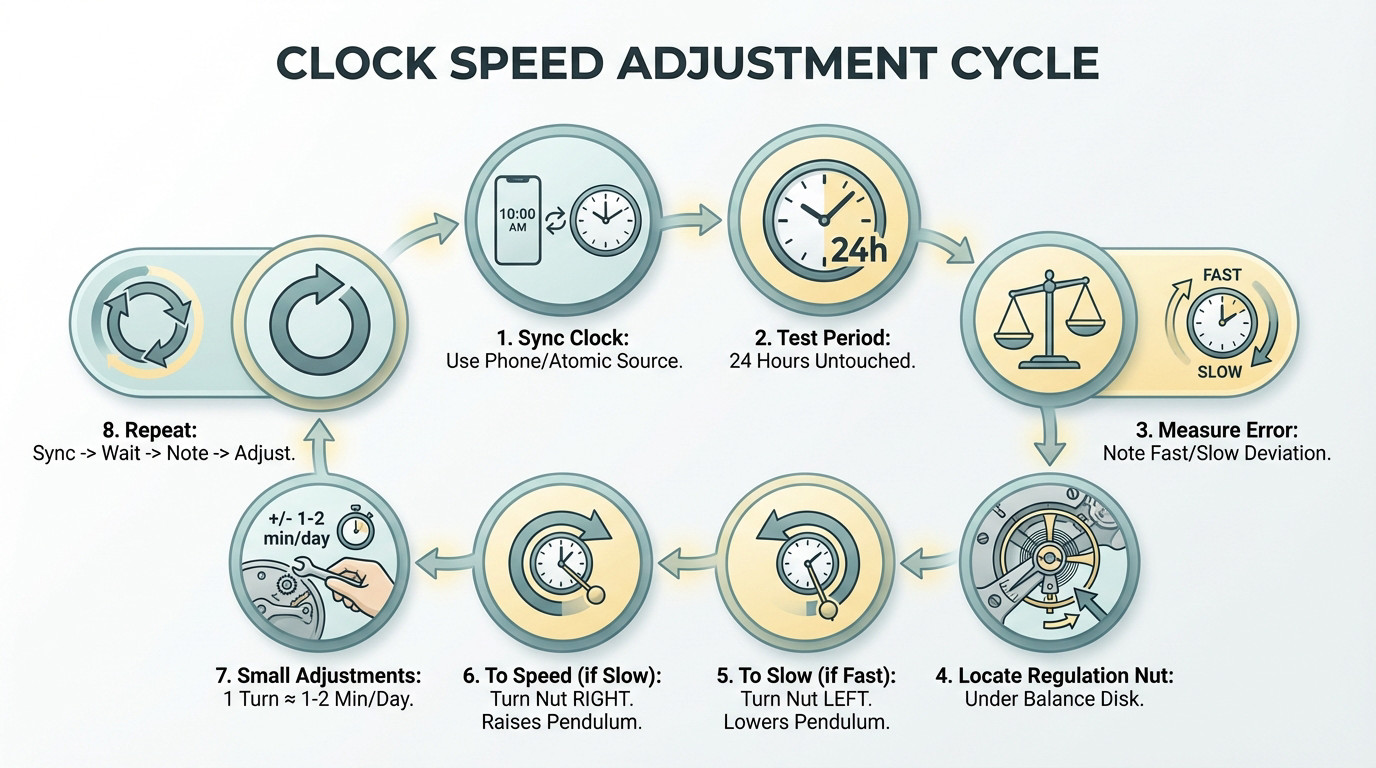
First, you need a baseline. Synchronize your mechanical clock to the exact second. Don't guess; use a reliable time source like your phone or an online atomic clock for absolute precision.
Now, walk away. You must let the mechanism run completely undisturbed for a test period of exactly 24 hours.
Once the day is up, compare the time. Does the clock run fast or run slow? Note the specific deviation. Knowing if it's off by seconds or minutes is vital for the next step.
Making the Adjustment: The Role of the Regulation Nut
Locate the regulation nut found directly underneath the pendulum disk, known as the "bob". Its sole function is simple: it moves this weight up or down to change the physics.
Here is the golden rule on how to regulate a pendulum clock. To slow down the clock because it's racing, turn the nut left. This lowers the bob and effectively lengthens the pendulum.
Conversely, to speed up the clock if it's lagging, turn the nut right to raise the bob.
The Rule of Thumb for Small Adjustments
Don't go wild twisting the nut. Proceed with tiny touches. Usually, one full rotation corresponds to a time shift of roughly one to two minutes per day.
The entire regulation cycle boils down to this disciplined routine:
- Synchronize the time.
- Wait 24 hours.
- Note the error.
- Make a small adjustment.
- Repeat.
From Guesswork to Precision: Finding Your Clock's 'Time Equation'
Random adjustments driving you crazy? It is time to adopt an expert approach for surgical precision.
The One-Turn-Test: A Systematic Approach
Stop nudging the nut blindly hoping for the best. Instead, give the rating nut a full 360-degree turn immediately. Do this in the specific direction needed to fix the current timing error.
Now, simply walk away and let the clock run for exactly 24 hours. Check the time against a reliable digital source. The difference between yesterday's error and today's new offset reveals your clock's unique sensitivity.
Calculating Your Clock's Personal Adjustment Ratio
Let’s look at the concrete math here. If your clock was gaining 3 minutes, and after one full turn it gains only 1 minute, that single turn equals a 2-minute correction per day.
You have now solved your clock's specific "time equation." If you need to fix a 1-minute error next week, you know exactly what to do: make a precise half-turn. It is the end of approximations.
Why This Method Saves You Time and Frustration
This systematic approach prevents the dreaded "over-adjustment" loop. You know, where you correct so hard you have to go back the other way. It stops the guesswork.
Mastering how to regulate a pendulum clock requires this shift in mindset.
Fixing the Heartbeat: How to Put Your Clock 'In Beat'
If the rhythm feels erratic despite your best efforts, the problem likely isn't speed. You need to stop looking at the hands and start listening to the heartbeat of the machine.
Diagnosing an 'Out of Beat' Clock: What to Listen For
A clock "in beat" produces a specific, satisfying sound. The time interval between the "tick" and the "tock" is perfectly equal. It shouldn't limp; it should sound consistent, almost hypnotic.
Conversely, an out of beat clock sounds uneven, like a galloping horse: "tick-tock... tick-tock...". This isn't a simple speed issue you can fix with the pendulum nut, but a mechanical imbalance that will eventually stop the clock entirely.
The Beat Adjustment: A Simple Fix for a Common Problem
Here is the secret to how to regulate a pendulum clock: you must adjust the crutch arm. This metal fork extends from the escapement to push the pendulum. It is the component responsible for creating that even "beat" we are chasing.
For many movements, a gentle, calculated twist of this rod is the fix. On others, you simply rotate a friction sleeve holding it. It requires a delicate touch, but shifting this geometry is the only way to restore the rhythm.
A Note on Wall Clocks vs. Mantel Clocks
For a wall clock, don't open the case yet. Gravity is your best tool. Often, simply tilting the bottom of the case slightly left or right aligns the beat instantly. It might look crooked, but the sound will be perfect.
Mantel clocks are stubborn. Since you can't prop up one side without it looking ridiculous, the adjustment must be internal. You have to manipulate the beat adjustment mechanism or the crutch directly to get it right.
When Regulation Fails: Troubleshooting Deeper Issues
You have twisted the nut, checked the beat, yet silence falls. If you are still wondering how to regulate a pendulum clock effectively, the problem might not be the regulation at all, but something hiding in the mechanics.
Common Reasons Your Pendulum Stops Swinging
First, check the obvious power source. Is the clock completely wound tight? It sounds foolish, but even experts overlook this simple lack of tension.
Other culprits often hide in plain sight:
- The pendulum bob often rubs against the case, the weights, or even the glass door, killing the momentum instantly.
- Your suspension spring—that tiny metal strip holding the pendulum—might be kinked or snapped.
- The hands sometimes catch on each other, creating invisible friction.
The Definitive Troubleshooting Guide
| Symptom | Likely Cause | Your Next Step |
| Clock runs fast | Pendulum is too short | Turn regulation nut left to lower the bob. |
| Clock runs slow | Pendulum is too long | Turn regulation nut right to raise the bob. |
| Uneven 'tick-tock' sound | Clock is out of beat | Check if level; adjust the crutch arm. |
| Pendulum stops after a few minutes | Lack of power or obstruction | Ensure it's fully wound; check for rubbing; inspect suspension spring. |
| Adjustments have no effect | Worn/dirty mechanism | The clock likely needs professional cleaning and oiling. |
Knowing When To Call A Professional
Don't just slap oil on a stopped mechanism. Adding lubricant to dirt creates an abrasive grinding paste. This mixture slowly destroys the pivots inside the movement. You risk ruining the antique entirely.
If these steps fail, stop tinkering immediately. Forcing the gears causes expensive, irreversible damage. Call a qualified horologist to handle the internal restoration.
Regulating your pendulum clock is a blend of simple physics and patience. By systematically adjusting the nut, ensuring the case is level, and listening to the beat, you can restore accurate timekeeping. If precision remains elusive despite these efforts, consult a professional to preserve your timepiece’s longevity.
FAQ
Is it safe to move the clock hands backwards?
In most antique clock mechanisms, you should never move the hands counter-clockwise. Doing so can damage the lifting levers inside the striking mechanism, causing the clock to jam or strike incorrectly. Always advance the time by moving the minute hand clockwise, pausing at each hour and half-hour to let the clock strike fully.
Why does my pendulum stop swinging after a few minutes?
If your pendulum won't stay swinging, the clock is likely not perfectly level or is "out of beat," meaning the tick and tock sounds are uneven. It could also be a physical obstruction; ensure the pendulum bob isn't rubbing against the back of the case, the weights, or the glass door, and verify that the clock is fully wound.
How do I fix a clock that is 'out of beat'?
An "out of beat" clock sounds like a galloping horse (long-short-long-short) rather than a steady rhythm. For wall clocks, try slightly tilting the case left or right until the tick-tock is even. For mantel or floor clocks, you may need to adjust the crutch arm—the rod connecting the escapement to the pendulum—by gently bending or twisting it toward the side with the shorter beat.
How can I slow down a grandfather clock that runs too fast?
To slow down a clock, you must lengthen the pendulum, as physics dictates that a longer pendulum swings slower. Locate the regulation nut at the bottom of the pendulum bob (disk) and turn it to the left to lower the bob. Make small adjustments, such as one full turn, and wait 24 hours to check the accuracy before adjusting again.
What should I do if the clock hands are misaligned or touching?
Clock hands are made of thin, pliable metal and can easily get bent, causing them to touch each other or the clock glass, which will stop the mechanism. If they are touching, gently bend them apart so they have clearance to pass one another freely. If they are misaligned with the hour strike, the hand's friction fit usually allows you to carefully shift the hour hand to the correct position.
How do I restart a clock that seems 'overwound'?
The term "overwound" is largely a myth; a clock usually stops because the mechanism is dirty or the oil has dried into a gummy paste, not because the spring is too tight. Do not force the key. Instead, check that the clock is level and the hands aren't obstructed. If it still refuses to run, the movement likely requires professional cleaning rather than more winding.
How do I properly balance or level my pendulum clock?
A pendulum clock requires a stable, perfectly level surface to operate correctly. Use a spirit level to check the case from side-to-side and front-to-back. If the clock leans, the escapement will not engage evenly, leading to an irregular beat and eventually causing the pendulum to stop swinging.
Can I use WD-40 to lubricate my clock movement?
Absolutely not. You should never use WD-40 or similar household sprays on a clock movement. These substances attract dust and eventually dry into a sticky sludge that will seize the pivots and destroy the mechanism. Only use specialized high-quality clock oil applied sparingly to the pivots, or have the clock serviced by a professional.